What Shin Splints Actually Are: 3-Step Mechanical Cure

Key Takeaways:
The Anatomy of Pain: Shin splints are not just "tight muscles." They are micro-traumas where the muscle is literally pulling away from the bone.
The Ice Illusion: The R.I.C.E. method (Rest, Ice, Compression, Elevation) delays healing by cutting off the inflammatory response your body needs to rebuild tissue.
Wolff’s Law: Bones and connective tissues adapt to the loads placed upon them. Complete rest makes your shins weaker, guaranteeing the pain will return.
The Mechanical Cure: To permanently fix shin splints, you must remodel the tissue through progressive isometric loading and biomechanical correction.
If you are a runner, a rucker, or a functional athlete, you likely know the piercing, throbbing pain that radiates down the front of your lower legs. Shin splints are the grim reaper of cardiovascular progress.
When you get them, the conventional fitness and medical industries hand you the same tired script: "Take two weeks off, take some ibuprofen, and ice it."
At Athalon Fitness, we reject this passive approach. Masking the pain with ice and anti-inflammatories does not change the biological mechanics that caused the injury. To permanently fix shin splints, you have to stop treating them like a mystery illness and start treating them like a structural failure.
What Are Shin Splints, Exactly? (The Anatomy of the Tear)
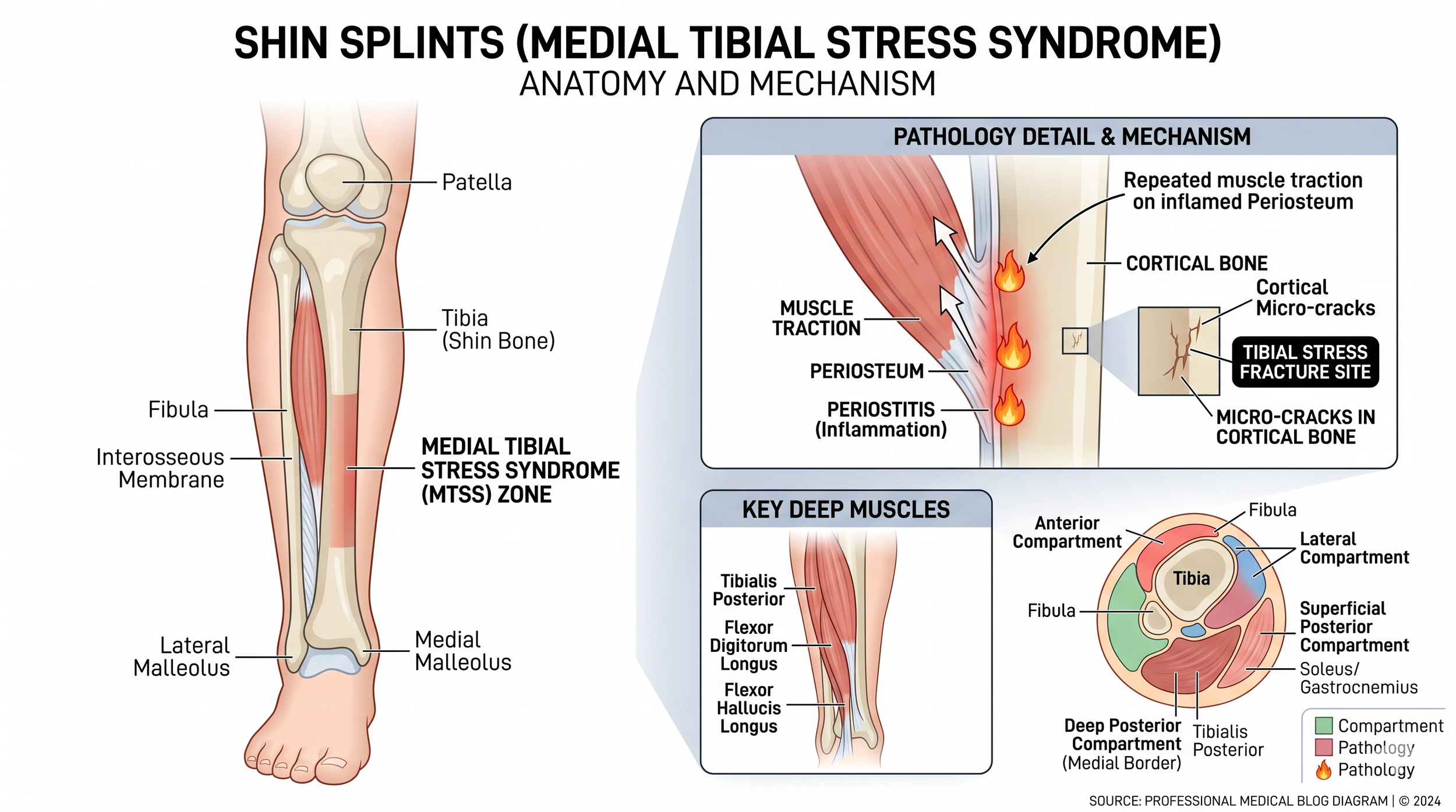
"Shin splints" is a catch-all term, but the clinical diagnosis is Medial Tibial Stress Syndrome (MTSS).
To understand MTSS, you have to visualize your lower leg. The tibia (shin bone) is wrapped in a thin, sensitive sheath of tissue called the periosteum. Your lower leg muscles—specifically the tibialis anterior and the soleus—attach directly to this sheath.
When you strike the ground, your body absorbs forces up to three times your body weight. If your foot mechanics are poor, or if your "shock absorber" muscles are weak, that massive force yanks on those muscle attachments.
Eventually, the muscle fibers begin to literally micro-tear away from the bone. The periosteum becomes violently inflamed. That deep, aching, sometimes sharp pain you feel isn't just soreness; it is the feeling of your connective tissue struggling to hold onto your skeleton. If left ignored, these micro-tears can escalate into a full-blown tibial stress fracture.
Why "Rest and Ice" is a Trap
In 1978, Dr. Gabe Mirkin coined the R.I.C.E. protocol. Decades later, even Dr. Mirkin himself retracted it, stating that ice actually delays recovery. Inflammation is not the enemy; it is the biological mechanism of repair. When you ice a shin splint, you constrict blood vessels, trapping cellular waste in the joint and preventing repairing macrophages from reaching the micro-tears.
Furthermore, complete rest violates Wolff’s Law, the biological principle that bone grows and remodels in response to the forces placed upon it. If you sit on the couch for a month, your tibia becomes less dense. The moment you start running again, the shin splints return with a vengeance.
The Athalon "Iron Tibia" Protocol: The 3-Step Cure
To cure MTSS, we must stop the shearing force, remodel the tissue, and build the "brakes."
Step 1: The Isometric Pain-Relief Hold
Before we can strengthen the area, we must calm the nervous system without using ice. Isometrics (contracting a muscle without moving the joint) have been clinically proven to create a natural analgesic (pain-killing) effect in injured tendons.
The Move: Sit on the floor with your legs straight. Loop a heavy resistance band around your toes and anchor it to something sturdy in front of you.
The Action: Pull your toes toward you against the band's resistance and hold that position.
The Goal: 4 sets of 45-second holds. This signals the brain to lower the pain threshold while safely sending blood to the periosteum.
Step 2: Remodel the "Brakes" (The Tibialis Raise)
As discussed in our biological movement frameworks, the Tibialis Anterior is your primary decelerator. If it is weak, the bone takes the impact.
The Move: The Wall Tibialis Raise. Stand leaning against a wall, heels 12 inches away from the baseboard.
The Action: Lock your knees and pull your toes up toward your shins. Slowly lower them.
The Goal: 3 sets of 20 reps. This high-rep movement acts as a "metabolic pump," shuttling oxygenated blood into the "white tissue" of the lower leg to accelerate healing.
Step 3: Fix the Strike (The Biomechanical Reset)
You cannot out-train a terrible running stride. The leading cause of MTSS is over-striding and aggressive heel-striking. When you reach too far forward with your foot, you create a "braking force" that sends a shockwave straight into the tibia.
The Fix: Increase your cadence (steps per minute). Aim for a cadence of 170–180 BPM. By taking shorter, faster steps, your foot naturally lands underneath your center of mass, shifting the load from the shin bone to the larger, more capable muscles of the glutes and hamstrings.
Conclusion: Rebuild the Chassis
Shin splints are not a badge of honor, nor are they a life sentence. They are simply an engine warning light telling you that your chassis is taking too much damage.
Throw away the ice packs. Stop completely resting. By actively remodeling the tissue with isometrics, building an "Iron Tibia" to absorb force, and correcting your stride, you can permanently erase Medial Tibial Stress Syndrome from your athletic life.
Works Cited & Research
Galbraith, R. M., & Lavallee, M. E. (2009). "Medial tibial stress syndrome: conservative treatment options." Current Reviews in Musculoskeletal Medicine. Link to Study
Moen, M. H., et al. (2009). "Medial tibial stress syndrome: a critical review." Sports Medicine.
Rio, E., et al. (2015). "Isometric exercise induces analgesia and reduces inhibition in patellar tendinopathy." British Journal of Sports Medicine. (Note: Mechanics apply to all tendinopathy and periostitis conditions).
Mirkin, G. (2015). "Why Ice Delays Recovery." DrMirkin.com.
FAQ
Q: Should I run through the pain of shin splints?A: No. Running through sharp pain can lead to a tibial stress fracture. However, you should not rest completely. Switch to low-impact loading (like cycling or swimming) and perform isometric shin exercises until the sharp pain subsides.
Q: How long does it take for shin splints to heal?A: With the traditional "rest" method, they often return immediately. With a proactive, mechanical loading protocol, mild to moderate MTSS can resolve in 3 to 6 weeks as the bone and connective tissue remodel to handle the stress.
Q: Do compression sleeves work for shin splints?A: Compression sleeves can increase local blood flow and provide a feeling of stability, but they are a temporary band-aid. They do not fix the underlying biomechanical weakness or bone density issues causing the pain.
