Bulletproof Your Feet : Supportive Shoes Are Destroying Your Joints
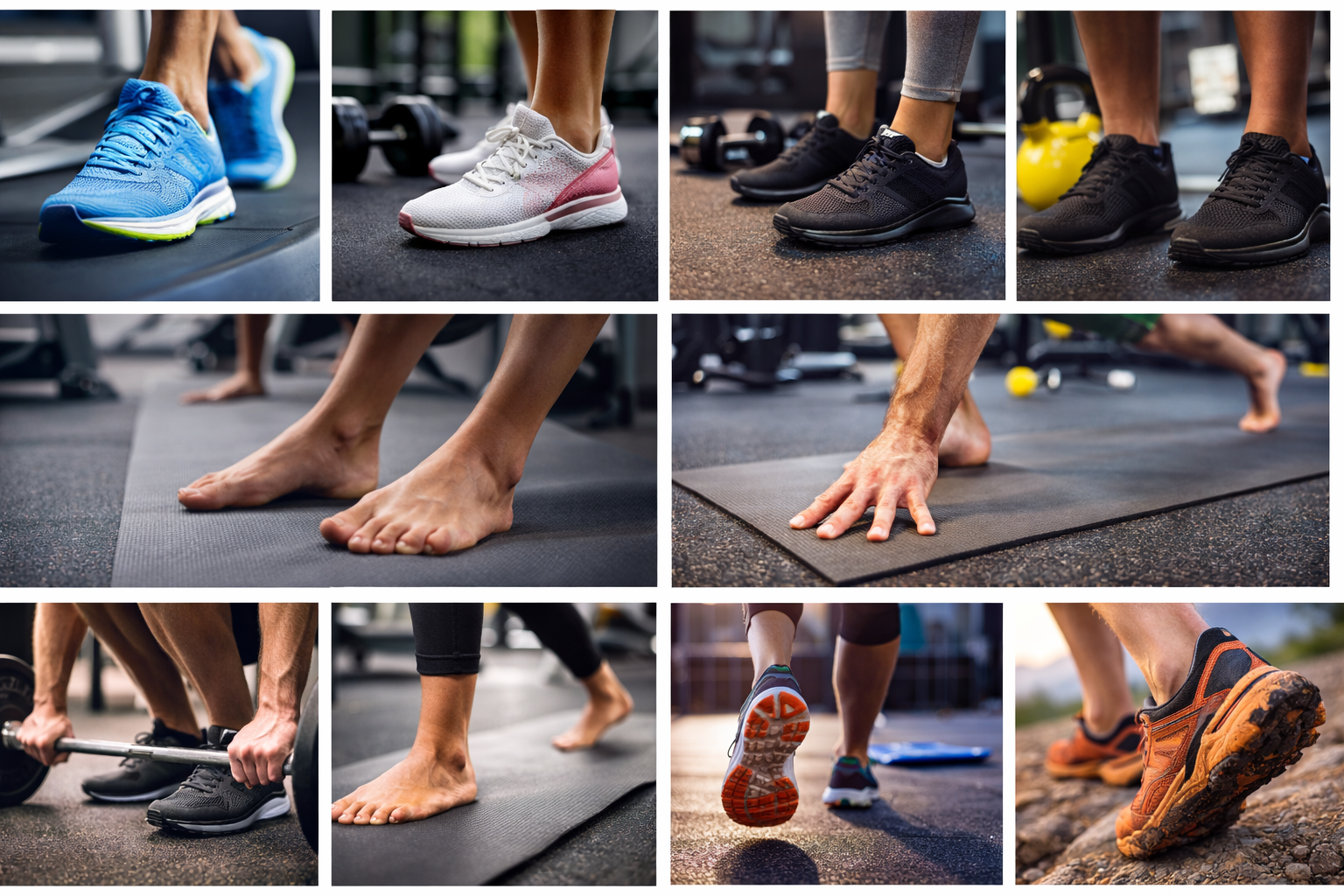
Key Takeaways:
The Problem: Modern footwear acts like a cast. Narrow toe boxes and extreme arch support cause the muscles in your feet to atrophy, leading to pain.
The Diagnosis: Conditions like Plantar Fasciitis are often symptoms of structural weakness, not just inflammation.
The Kinetic Chain: A collapsed arch doesn't just hurt your foot; it causes your knees to cave inward, leading to hip and lower back pain.
The Fix: Transitioning to "zero-drop," wide-toe-box shoes and using toe spacers can structurally rebuild your foot mechanics.
If you break your arm, a doctor puts it in a cast. The cast provides rigid support, preventing movement so the bone can heal. But what happens when the cast comes off six weeks later? Your arm is weak, stiff, and the muscles have visibly shrunk.
Now, look at your running shoes.
Thick cushioning, rigid heel counters, and massive artificial arch supports. We have been sold the idea that to protect our feet, we need to brace them. But physiologically, wrapping your foot in a highly supportive shoe is identical to putting it in a cast. You are bracing a healthy joint, and as a result, the intrinsic muscles of your feet are quietly wasting away.
If you suffer from foot pain, shin splints, or bad knees, the solution isn't to buy a shoe with more support. The solution is to wake your feet up.
The Anatomy of a "Shoe-Shaped" Foot
The human foot is an evolutionary masterpiece. It contains 26 bones, 33 joints, and over 100 muscles, tendons, and ligaments. It is designed to be a dynamic, shock-absorbing spring.
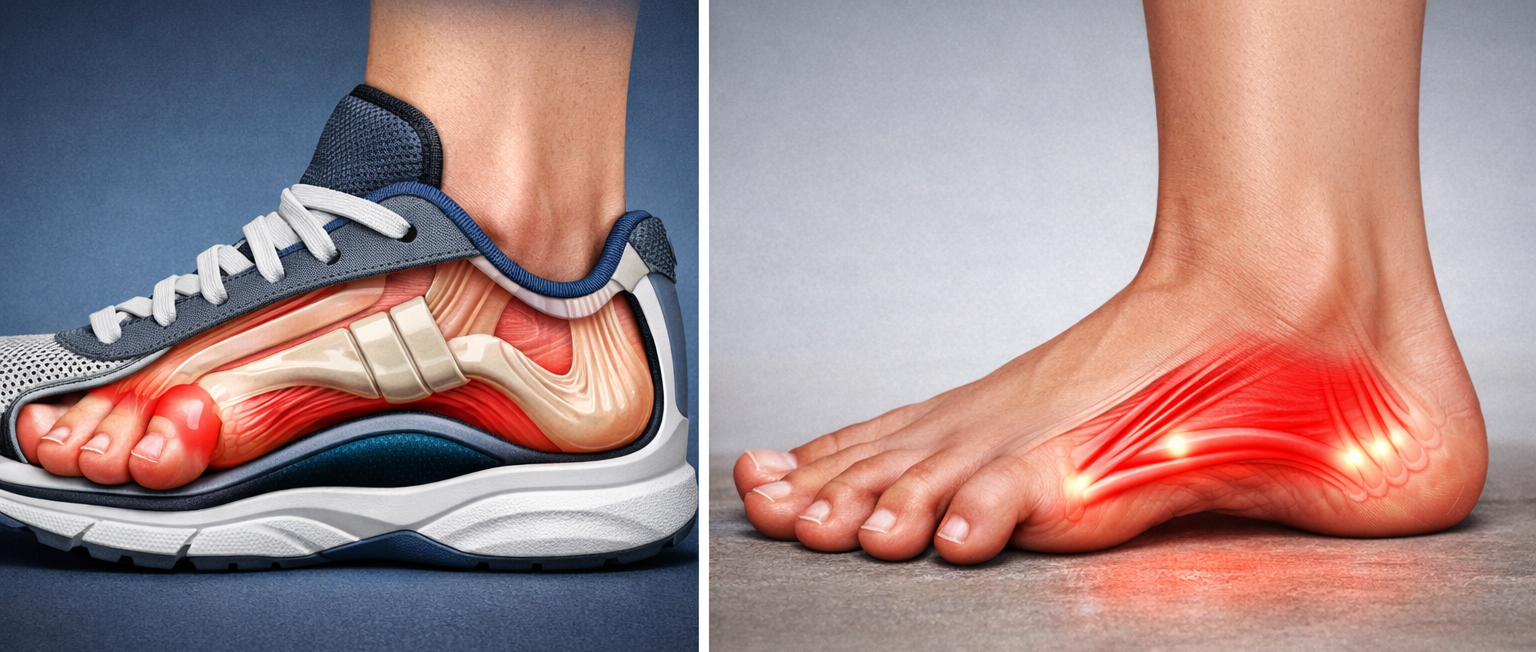
However, modern shoes suffer from two massive design flaws that ruin this spring:
1. The Narrow Toe Box (The Bunion Maker)
Look at a baby’s foot: the toes are the widest part. Now look at an adult's foot: it comes to a point. Modern shoes taper at the end for aesthetic reasons. This forces your toes together, deactivating your big toe (the hallux). When your big toe cannot splay outward to anchor your foot, you lose your primary balance mechanism. This structural deformity is the direct cause of bunions.
2. Elevated Heels and "Zero Drop"
Most athletic shoes have an elevated heel (the heel is 10–15 millimeters higher than the toes). This permanently shortens your Achilles tendon and shifts your center of mass forward. To fix this, you want a "zero-drop" shoe, where the heel and forefoot are on the exact same level, allowing your Achilles to stretch to its natural length.
The Arch Support Myth and Plantar Fasciitis
When people get heel pain, the first thing a podiatrist usually prescribes is a rigid orthotic to support the arch.
While this provides temporary relief, it is a long-term disaster. The arch of your foot is an architectural marvel. In engineering, an arch gets its strength from being loaded from the top down; if you push an arch up from the bottom (like an orthotic does), it actually weakens the structure.
By constantly artificially supporting your foot, the tiny intrinsic muscles under your foot turn off. The fascia (connective tissue) gets tight and brittle. The moment you take a step barefoot, the weak fascia tears microscopically. This is Plantar Fasciitis.
You cannot "cushion" your way out of weakness. You have to rebuild the strength.
The Kinetic Chain: Why Your Back Pain Starts in Your Feet
Your foot is the steering wheel for your knee.
When you have weak, shoe-shaped feet, your arch collapses inward every time you take a step. This is called overpronation.
Because your body is a connected kinetic chain, when the foot collapses inward, the shinbone rotates inward. This causes the knee to cave in (valgus tracking), which pulls the hip out of alignment, ultimately manifesting as lower back pain.
If you have chronic knee or back pain that won't go away, stop looking at your back. Look at the ground.
The Barefoot Protocol: How to Rebuild Your Feet
You cannot go from wearing heavily cushioned shoes for 20 years to running a 5K barefoot tomorrow. You will snap your Achilles. It requires a slow, deliberate transition.
Phase 1: Toe Spacers (The Retainer for Your Feet)
Just like braces fix crooked teeth, toe spacers fix crooked toes. Wear silicone toe spacers (like Correct Toes) for 30 minutes a day while walking around your house. This physically stretches the ligaments back to their natural, wide-splayed position.
Phase 2: Barefoot Time & "Short Foot" Exercises
Spend as much time as possible walking barefoot on natural surfaces (grass, sand). To build the arch, practice the "Short Foot" exercise:
Stand flat on the floor.
Without curling your toes, try to pull the ball of your foot toward your heel, contracting the arch.
Hold for 5 seconds. Repeat 10 times per foot.
Phase 3: The Wide Toe-Box Shoe
Throw away shoes that squeeze your toes. Transition your daily walking shoes to a "barefoot" or minimalist brand (like Vivobarefoot, Xero, or Altra). These shoes feature a wide toe box so your foot can splay, and a zero-drop, highly flexible sole so your foot can actually feel the ground and engage its muscles.
Conclusion: Free Your Feet
We have spent decades trying to outsource the job of our muscles to foam and plastic. But biomechanics cannot be cheated.
By freeing your feet from the rigid casts of modern footwear, you reawaken a massive sensory network. You build indestructible arches, you align your knees, and you restore the natural shock-absorbing spring you were born with.
The best piece of fitness equipment you own is at the end of your legs. It's time to start using it.
Frequently Asked Questions (FAQ)
Q: Are barefoot shoes good for running? A: Yes, but only after a very long transition period. Running in minimalist shoes forces you to land on your midfoot/forefoot, which is mechanically superior to heel-striking. However, if you switch too fast without building calf and Achilles strength, you risk severe injury.
Q: Can toe spacers really fix bunions? A: Toe spacers can halt the progression of mild to moderate bunions and significantly relieve pain by realigning the big toe joint. However, severe, fully calcified bunions may still require surgery.
Q: Is walking barefoot on hardwood floors bad? A: If your feet are weak, hard surfaces can cause initial discomfort. But as the fat pad on the bottom of your foot thickens and your arch muscles strengthen, walking barefoot on any surface becomes natural and healthy.
Works Cited
Lieberman, D. E., et al. (2010). Foot strike patterns and collision forces in habitually barefoot versus shod runners. Nature, 463(7280), 531-535. https://doi.org/10.1038/nature08723
Ridge, S. T., et al. (2019). Foot bone marrow edema after a 10-wk transition to minimalist running shoes. Medicine & Science in Sports & Exercise, 45(7), 1363-1368.
McKeon, P. O., et al. (2015). The foot core system: a new paradigm for understanding intrinsic foot muscle function. British Journal of Sports Medicine, 49(5), 290-290. https://doi.org/10.1136/bjsports-2013-092690
Campion, K., et al. (2015). The effects of footwear on the kinetic and kinematic variables of running. Journal of Sports Sciences.
Kelly, L. A., et al. (2014). Intrinsic foot muscles have the capacity to control deformation of the longitudinal arch. Journal of The Royal Society Interface, 11(93), 20131188.
