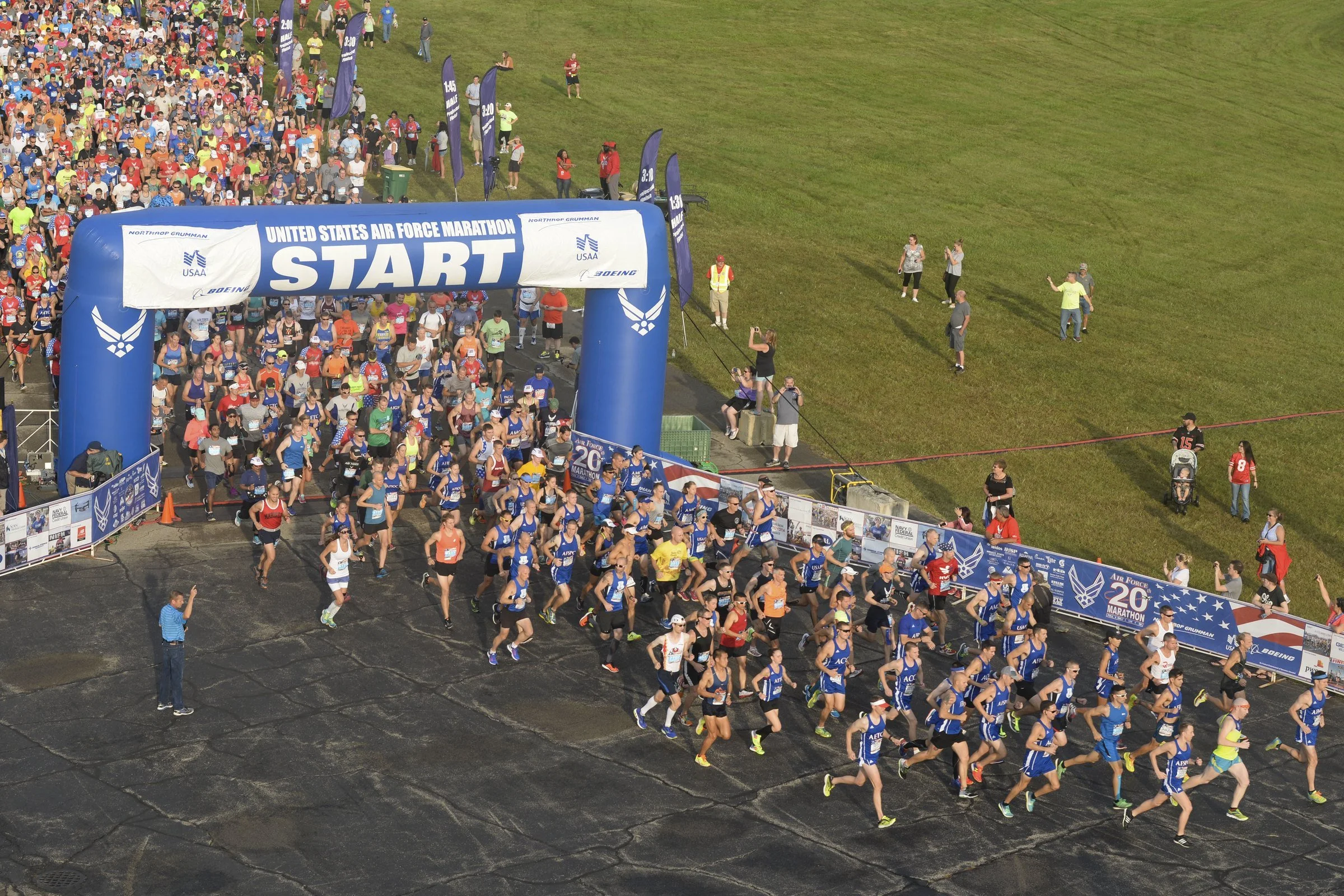
Photo: Wesley Farnsworth, U.S. Air Force / DVIDS via Wikimedia Commons, public domain (cropped and resized). Runners and walkers leave the start of the 2016 Air Force Marathon half marathon at Wright-Patterson Air Force Base, Ohio. Use of U.S. military imagery does not imply DoD endorsement.
Key Takeaways
Competition came out on top in the largest trial. In a 602-person randomized trial, a step game with a small competitive group added 920 daily steps versus control, more than support or collaboration designs (Patel et al., 2019).
Comparison can beat encouragement. Among 790 students, seeing how peers compared raised exercise-class attendance by about 90%, while a support-only team did no better than control (Zhang et al., 2016).
Game features help, modestly. Meta-analyses find small gains in activity from gamified programs and apps (Mazeas et al., 2022; Nishi et al., 2024).
Effects fade, and competition can mask strain. Gains shrink once a game ends, and head-to-head racing in the heat raised body temperature without feeling harder (Corbett et al., 2018).
Most people do not need another workout plan. They need a reason to show up on Tuesday. That is why competition and exercise keep getting paired: leaderboards, step challenges, workout partners and race entries all promise to turn intention into action.
The need is real. Worldwide, 31.3% of adults did not meet physical activity guidelines in 2022, up from 23.4% in 2000 (Strain et al., 2024). Mobile exercise apps climbed to No. 2 in ACSM's 2027 fitness trends, though ACSM notes that a high ranking "does not establish that a particular product or program is effective" (ACSM, 2026).
So does competition work outside a race? We have written about competition under extreme military stress in The Crucible Mindset. This post looks at everyday training: what controlled trials show about leaderboards, comparison and accountability, and where the limits are.
Competition and Exercise: What the Largest Trial Found
The STEP UP trial randomized 602 adults with overweight or obesity from 40 U.S. states. Everyone wore a step tracker and picked a step-goal increase. The control group got device feedback only. Three groups played a 24-week game with points and levels, built around support, collaboration or competition (Patel et al., 2019).
In the competition arm, participants were placed in groups of three people who usually did not know each other. Each week they received an email leaderboard ranking them on cumulative points (Patel et al., 2019).
All three game designs beat control while the game ran. Competition added 920 daily steps, support 689 and collaboration 637. During the 12-week follow-up, with the game switched off, only the competition arm remained significantly above control, at 569 extra steps per day (Patel et al., 2019).
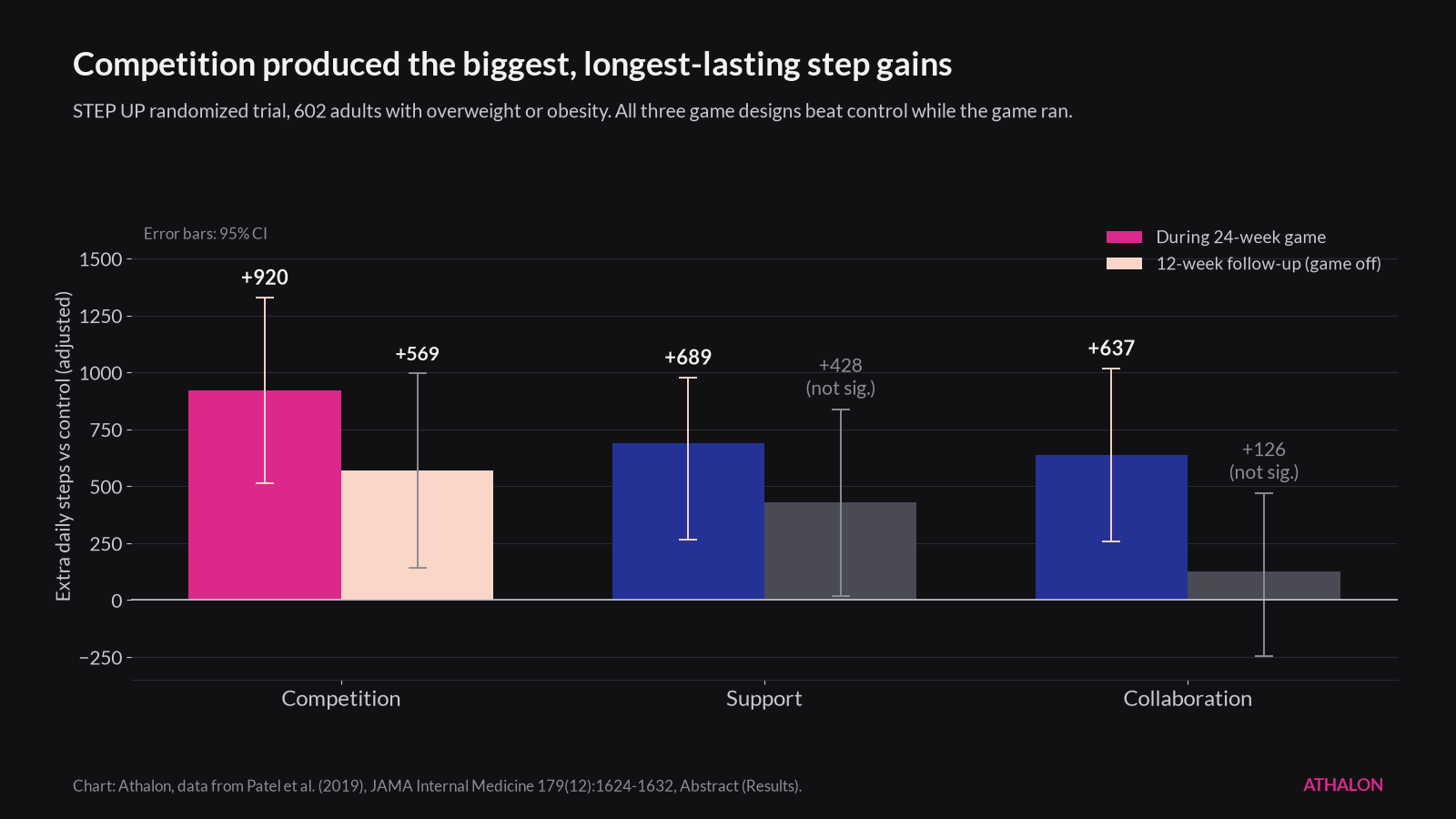
Chart: Athalon, data from Patel et al. (2019), JAMA Internal Medicine, Abstract (Results).
The gap held fairly steady. Competition participants logged 1,166 more steps per day than controls in month 1 and 1,022 more in month 6 (Patel et al., 2019).
Social Comparison vs Support: Who You Train With Matters
A University of Pennsylvania trial asked a sharper question: is it encouragement or comparison that gets people moving? It randomized 790 graduate and professional students into an 11-week exercise-class program (Zhang et al., 2016).
Groups that could see how peers or rival teams were doing averaged 35.7 and 38.5 class attendances per week. The control group averaged 20.3, and the support-only team averaged 16.8. Attendance was 90% higher in the conditions with comparison. The authors concluded that social comparison was more effective than social support (Zhang et al., 2016).
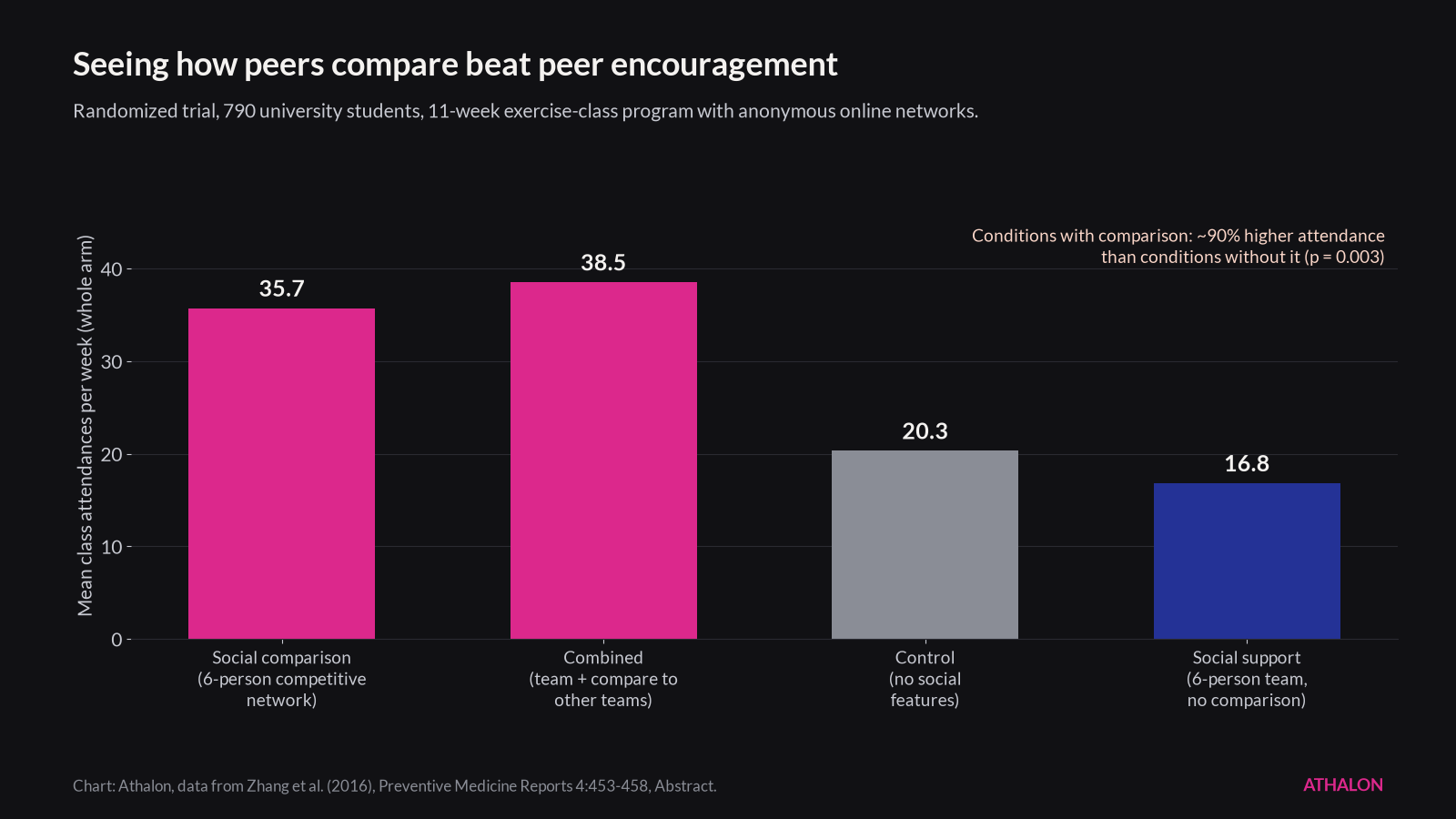
Chart: Athalon, data from Zhang et al. (2016), Preventive Medicine Reports, Abstract.
Support is not useless, though. In the BE FIT trial, a collaborative family game added 953 daily steps versus control (Patel et al., 2017). The STEP UP authors suggest that competition may work better than collaboration when participants have no existing social connection (Patel et al., 2019). Strangers may respond to a scoreboard; family and friends may respond to a shared goal.
Photo: Shixart1985 / Wikimedia Commons, CC BY 2.0 (cropped to square and resized). An athlete presses a dumbbell overhead while others watch at an indoor gym event.
Accountability and the "Weak Link" Effect
Accountability can be as simple as someone else counting on you. In a lab study of 115 participants holding plank exercises, people who exercised as the weaker member of a two-person online team held on 78.8 seconds longer, on average, than people exercising alone, a 33.6% gain. The partner was a prerecorded confederate who always appeared to outlast the participant (Irwin et al., 2013).
One finding runs against intuition. When the stronger partner offered verbal encouragement, exercise time was 31.14 seconds shorter than when the partner stayed silent (Irwin et al., 2013). The effect came from being needed, not from being cheered on.
What the Gamification Research Shows Overall
Single trials can mislead, so pooled data matter. A meta-analysis of 16 randomized trials (2,407 participants) found a small-to-medium effect of gamified interventions on physical activity (Hedges g = 0.42). The effect held against non-gamified activity programs (g = 0.23), but it was weaker at follow-up, averaging 14 weeks after the programs ended (g = 0.15). Leaderboards appeared in 7 of the 18 studies in the systematic review (Mazeas et al., 2022).
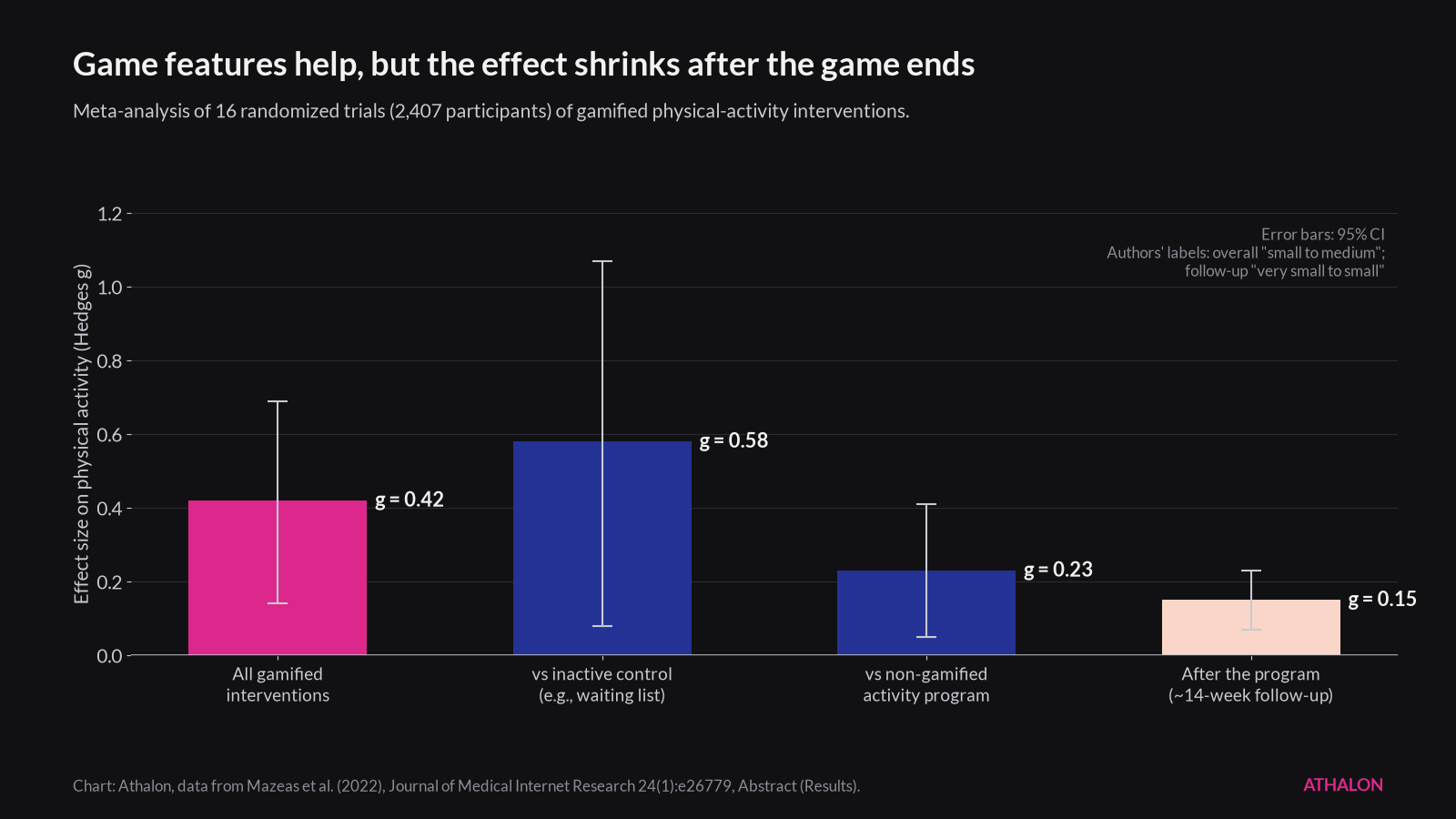
Chart: Athalon, data from Mazeas et al. (2022), Journal of Medical Internet Research, Abstract (Results).
A 2024 meta-analysis of 36 trials (10,079 participants) compared apps with and without game features. Gamified apps added 489 steps per day, which the authors rated a trivial increase (high certainty of evidence), plus small reductions in body fat (Nishi et al., 2024).
Design matters. In a trial of 180 veterans, gamification with a support partner did not significantly raise steps on its own. Adding a loss-framed financial incentive did, by 1,224 steps per day, but that gain was not sustained during follow-up (Agarwal et al., 2021).
When Competition Pushes Too Hard
Competition changes how hard effort feels. In a lab study, 18 men rode 20 km time trials. Heat slowed them, from 35:31 in cool conditions to 36:10 in the heat. Racing what they believed was another rider in the heat brought their time back to 35:17 (Corbett et al., 2018).
The cost: end-of-exercise rectal temperature and physiological strain were higher in the head-to-head race, while perceived exertion and thermal comfort did not differ from riding solo in the heat. The authors warn that this could increase heat-illness risk (Corbett et al., 2018).
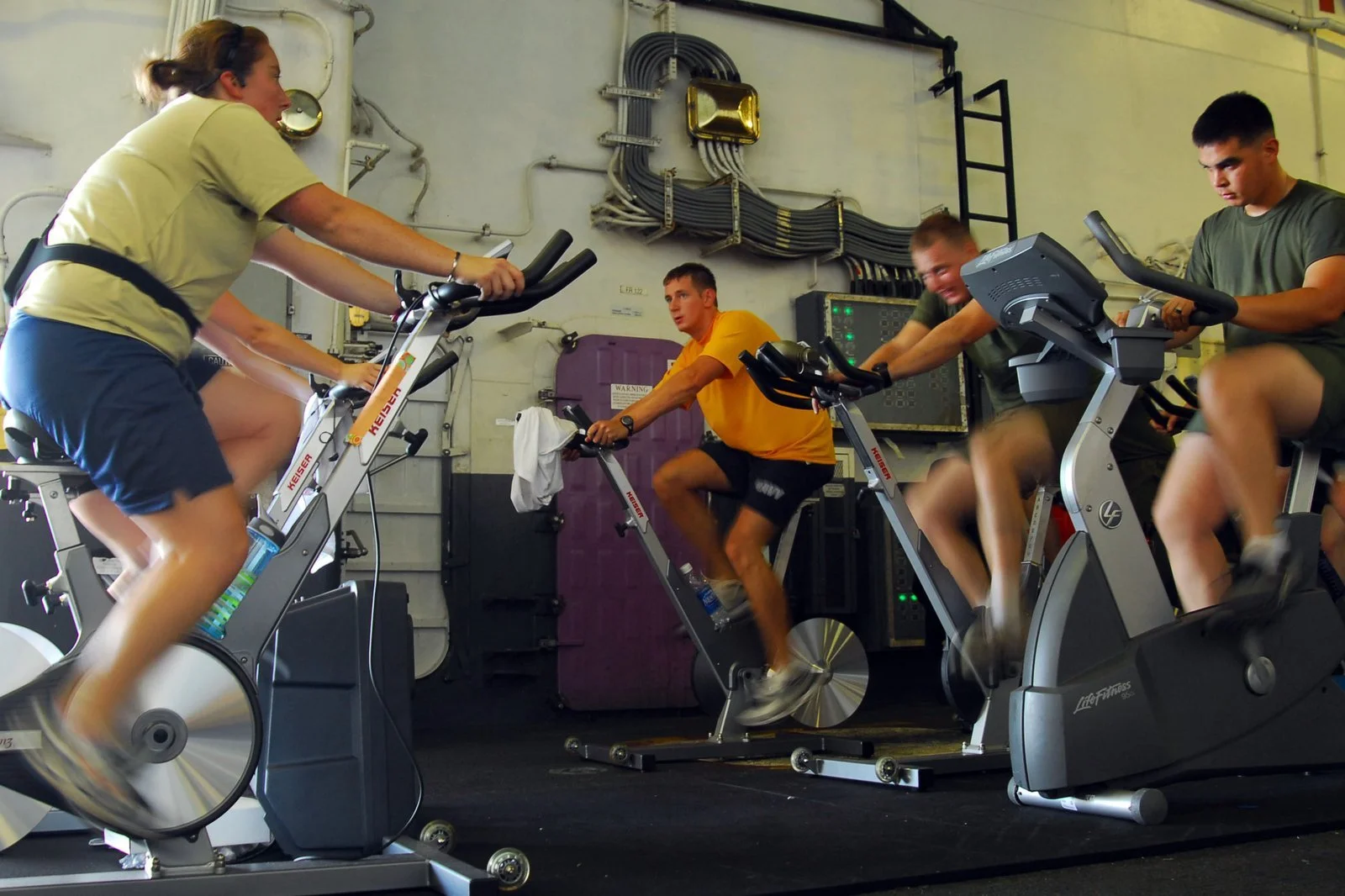
Photo: MC2 Drew Williams, U.S. Navy / Wikimedia Commons, public domain (cropped and resized). Sailors and Marines ride in a spin class aboard USS Bonhomme Richard (LHD 6) in 2009. Use of U.S. military imagery does not imply DoD endorsement.
How to Use Competition and Accountability Based on the Evidence
Compete in small groups. STEP UP used groups of three with a weekly leaderboard (tested in one large RCT) (Patel et al., 2019).
Score effort you control. STEP UP awarded points for hitting personal step goals rather than ranking raw totals. That this is fairer for beginners is our inference, not a tested result (Patel et al., 2019).
Match the format to the people. Use competition with acquaintances and shared goals with family (inferred from comparing trials) (Patel et al., 2017; Zhang et al., 2016).
Pair up with someone slightly better. Being the "weak link" extended plank time in a lab study (tested short-term only) (Irwin et al., 2013).
Plan for the end of the challenge. Effects shrink at follow-up, so schedule the next challenge or goal (inferred) (Mazeas et al., 2022).
Respect heat and recovery. Competition can raise strain without raising perceived effort (Corbett et al., 2018).
Limitations
Most trials here measured steps or class attendance, not fitness or health outcomes. STEP UP participants were college-educated employees of one consulting firm, which may limit generalizability, and the study was partly funded by that firm (Patel et al., 2019). The plank and cycling studies were short lab experiments with small samples. If you have a heart condition or another medical concern, talk with a qualified clinician before ramping up intensity.
Conclusion: A Scoreboard Helps You Show Up
Competition and exercise are a good fit when the format is right. Small groups, a visible leaderboard and goals scaled to each person produced the strongest results in the largest trial reviewed here. Comparison often motivated more than encouragement.
The effects are modest and fade when the game stops. Treat competition as a tool for consistency, and keep listening to your body when the scoreboard says push.
Make the next challenge easy to start. In the Athalon app you can create competitions with friends, log lifts and runs, and see where you stand on the leaderboard. Download Athalon on the App Store.
Frequently Asked Questions
Q: Does competition really increase exercise?
A: In the STEP UP trial, a competitive step game added 920 daily steps versus control, the largest effect of the three designs tested (Patel et al., 2019).
Q: Is a workout partner or a leaderboard better?
A: It depends on the relationship. Comparison beat team support among students who did not know each other, while a collaborative game worked within families (Zhang et al., 2016; Patel et al., 2017).
Q: Do fitness challenges keep working after they end?
A: Partly. Effects were smaller at follow-up in a meta-analysis of 16 trials, and in STEP UP only the competition arm stayed above control (Mazeas et al., 2022; Patel et al., 2019).
Q: Can competition be risky?
A: In hot conditions, head-to-head racing raised core temperature without feeling harder, which the authors say could raise heat-illness risk (Corbett et al., 2018).
References
Agarwal, A. K., Waddell, K. J., Small, D. S., Evans, C., Harrington, T. O., Djaraher, R., Oon, A. L., & Patel, M. S. (2021). Effect of gamification with and without financial incentives to increase physical activity among veterans classified as having obesity or overweight: A randomized clinical trial. JAMA Network Open, 4(7), e2116256. https://doi.org/10.1001/jamanetworkopen.2021.16256
American College of Sports Medicine. (2026, October 20). Wearables hold top spot in ACSM's 2027 fitness trends. https://acsm.org/2027-fitness-trends/
Corbett, J., White, D. K., Barwood, M. J., Wagstaff, C. R. D., Tipton, M. J., McMorris, T., & Costello, J. T. (2018). The effect of head-to-head competition on behavioural thermoregulation, thermophysiological strain and performance during exercise in the heat. Sports Medicine, 48(5), 1269–1279. https://doi.org/10.1007/s40279-017-0816-x
Irwin, B. C., Feltz, D. L., & Kerr, N. L. (2013). Silence is golden: Effect of encouragement in motivating the weak link in an online exercise video game. Journal of Medical Internet Research, 15(6), e104. https://doi.org/10.2196/jmir.2551
Mazeas, A., Duclos, M., Pereira, B., & Chalabaev, A. (2022). Evaluating the effectiveness of gamification on physical activity: Systematic review and meta-analysis of randomized controlled trials. Journal of Medical Internet Research, 24(1), e26779. https://doi.org/10.2196/26779
Nishi, S. K., Kavanagh, M. E., Ramboanga, K., Ayoub-Charette, S., Modol, S., Dias, G. M., Kendall, C. W. C., Sievenpiper, J. L., & Chiavaroli, L. (2024). Effect of digital health applications with or without gamification on physical activity and cardiometabolic risk factors: A systematic review and meta-analysis of randomized controlled trials. eClinicalMedicine, 76, 102798. https://doi.org/10.1016/j.eclinm.2024.102798
Patel, M. S., Benjamin, E. J., Volpp, K. G., Fox, C. S., Small, D. S., Massaro, J. M., Lee, J. J., Hilbert, V., Valentino, M., Taylor, D. H., Manders, E. S., Mutalik, K., Zhu, J., Wang, W., & Murabito, J. M. (2017). Effect of a game-based intervention designed to enhance social incentives to increase physical activity among families: The BE FIT randomized clinical trial. JAMA Internal Medicine, 177(11), 1586–1593. https://doi.org/10.1001/jamainternmed.2017.3458
Patel, M. S., Small, D. S., Harrison, J. D., Fortunato, M. P., Oon, A. L., Rareshide, C. A. L., Reh, G., Szwartz, G., Guszcza, J., Steier, D., Kalra, P., & Hilbert, V. (2019). Effectiveness of behaviorally designed gamification interventions with social incentives for increasing physical activity among overweight and obese adults across the United States: The STEP UP randomized clinical trial. JAMA Internal Medicine, 179(12), 1624–1632. https://doi.org/10.1001/jamainternmed.2019.3505
Strain, T., Flaxman, S., Guthold, R., Semenova, E., Cowan, M., Riley, L. M., Bull, F. C., Stevens, G. A., & Country Data Author Group. (2024). National, regional, and global trends in insufficient physical activity among adults from 2000 to 2022: A pooled analysis of 507 population-based surveys with 5.7 million participants. The Lancet Global Health, 12(8), e1232–e1243. https://doi.org/10.1016/S2214-109X(24)00150-5
Zhang, J., Brackbill, D., Yang, S., Becker, J., Herbert, N., & Centola, D. (2016). Support or competition? How online social networks increase physical activity: A randomized controlled trial. Preventive Medicine Reports, 4, 453–458. https://doi.org/10.1016/j.pmedr.2016.08.008
