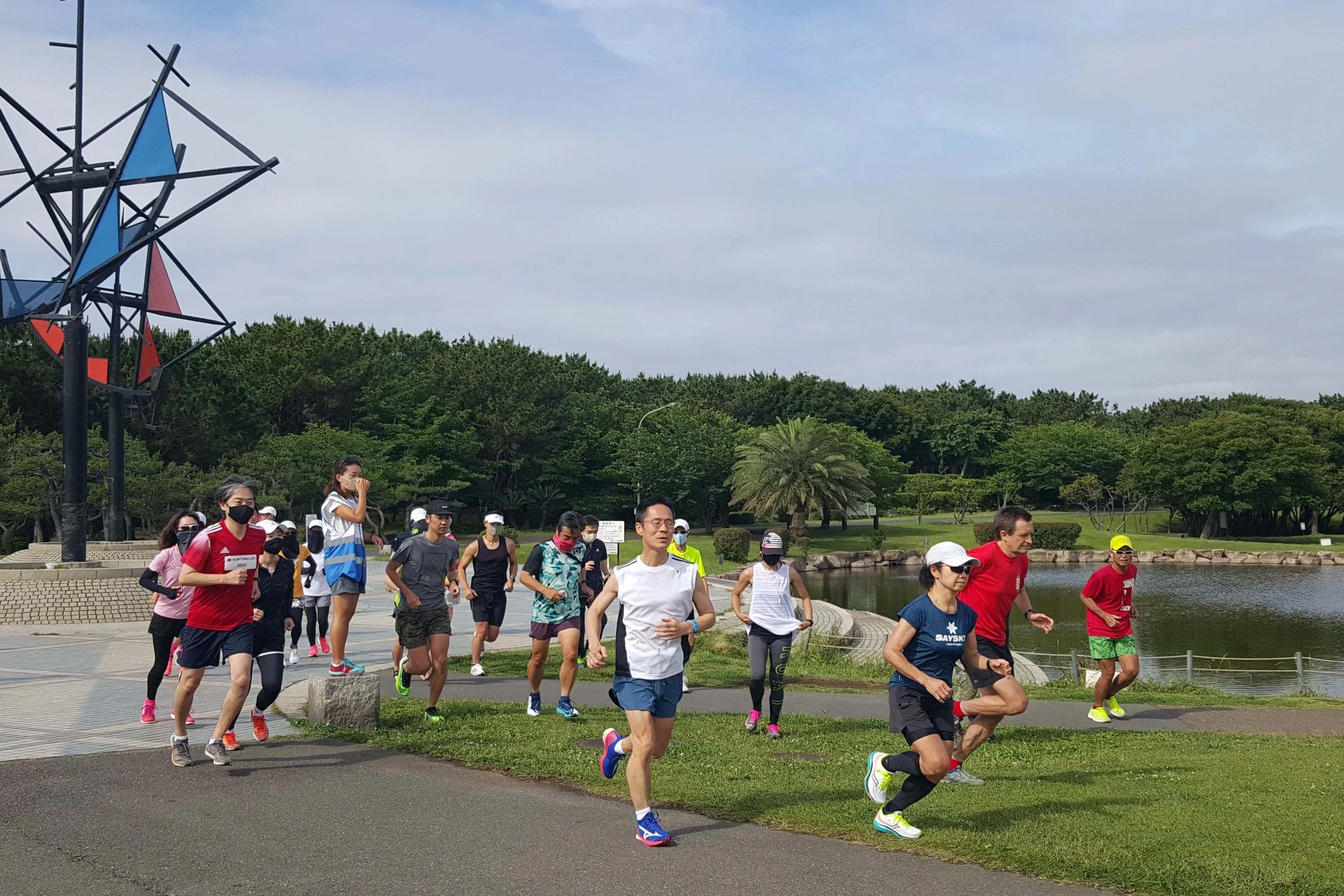
Photo: Yoshi Canopus / Wikimedia Commons, CC BY-SA 4.0 (cropped to 3:2 and resized). Runners set off at the start of a free weekly 5 km parkrun in Tsujido Seaside Park, Kanagawa, Japan, in June 2021.
Key Takeaways
Running pays off at almost any dose. Runners had a 27% lower risk of death from any cause than non-runners, with no clear extra benefit from running more (Pedisic et al., 2020).
Run club benefits are real, but groups are not magic. A 2026 meta-analysis of 71 studies found group and solo programs produced statistically equivalent changes in physical activity (Kritz et al., 2026).
Walking and running groups still deliver. Group walkers improved blood pressure, fitness and depression scores, with 75% mean adherence (Hanson & Jones, 2015).
The social part is the draw. At parkrun, social factors were linked to more enjoyment and energy, and feeling part of the group was linked to turning up more often (Davis et al., 2021; Stevens et al., 2019).
Training with other people is climbing the trend lists. In ACSM's 2027 fitness trends, group fitness classes jumped from No. 13 to No. 7, a rise ACSM linked to "opportunities to build social connections through exercise." ACSM also notes that a high trend ranking "does not establish that a particular product or program is effective" (ACSM, 2026).
So what are the real run club benefits? The timing matters: WHO's Commission on Social Connection reports that 1 in 6 people worldwide is affected by loneliness (WHO, 2025), and 31% of adults do not meet the global activity recommendation of at least 150 minutes of moderate activity per week (WHO, 2026). This post covers what running itself does, whether groups beat training alone, what the group walking and parkrun research shows, and how to use a club well.
Why Running Is Worth Doing at Almost Any Dose
Before asking whether to run with others, it helps to know what running alone is worth. A meta-analysis of 14 studies from six prospective cohorts (232,149 participants) found running was associated with 27%, 30% and 23% lower risk of all-cause, cardiovascular and cancer death compared with no running (Pedisic et al., 2020).
More was not clearly better. The authors found no significant dose-response trend for weekly frequency, duration, pace or total volume, and concluded that "any amount of running, even just once a week, is better than no running" (Pedisic et al., 2020). These are observational cohorts, so they show association, not cause.
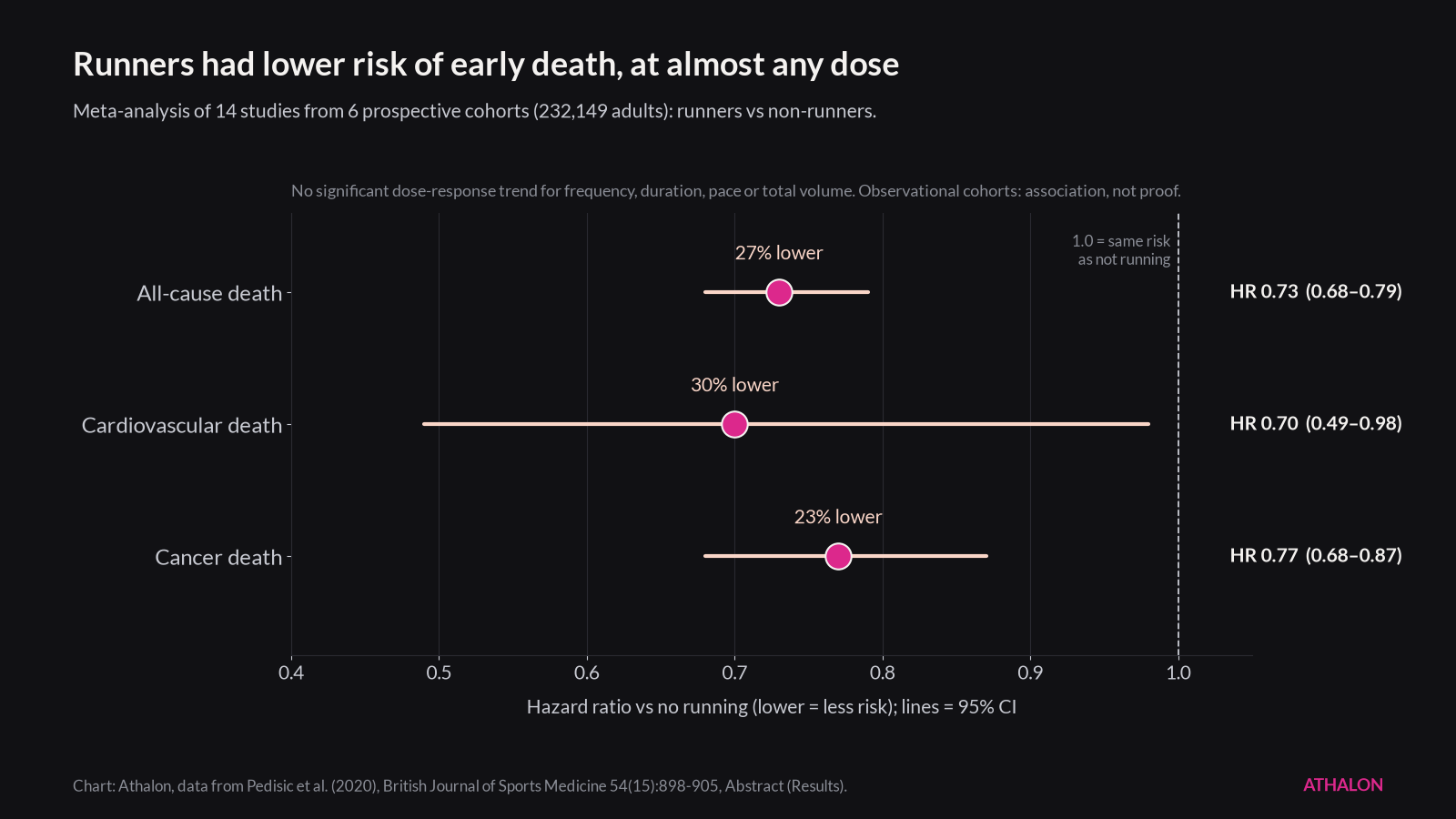
Chart: Athalon, data from Pedisic et al. (2020), British Journal of Sports Medicine, Abstract (Results).
Do Group Programs Beat Training Alone?
Here the evidence is more modest than the trend. A 2026 meta-analysis in Nature Human Behaviour compared group-based and individual physical activity programs across 71 studies. Group programs showed a small, non-significant advantage for physical activity (Hedges' g = 0.086), psychosocial outcomes and health outcomes (Kritz et al., 2026).
A formal equivalence test found that group and individual programs "produce statistically equivalent changes in PA." For functional outcomes such as strength and balance, groups showed a small significant advantage only after outliers were removed. "True groups," which deliberately use group-dynamics strategies, had slightly larger effects on health outcomes (Kritz et al., 2026).
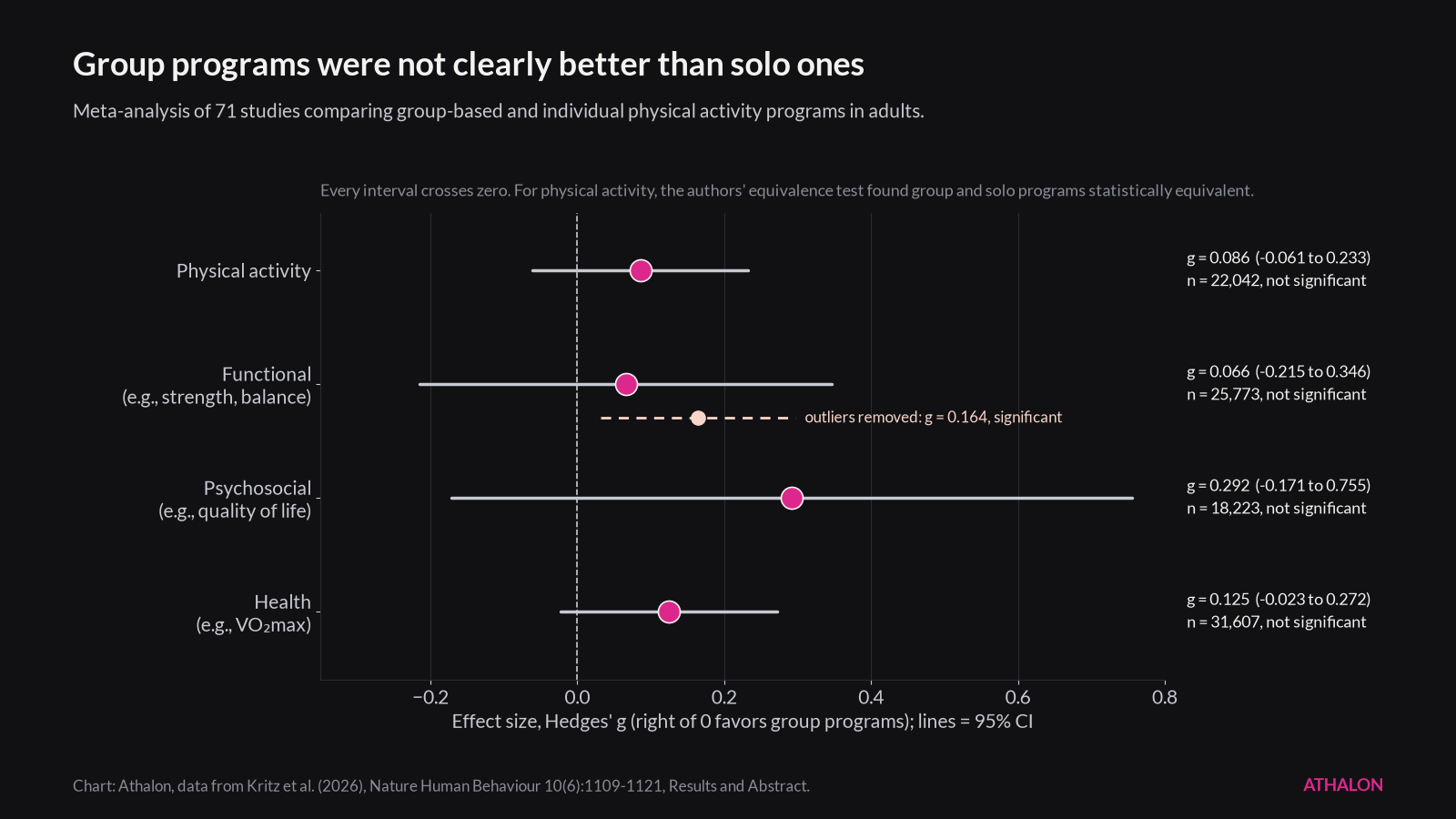
Chart: Athalon, data from Kritz et al. (2026), Nature Human Behaviour, Results and Abstract.
The authors' conclusion is practical: "Both individual and group-based approaches (in-person or online) may be effective." They suggest letting people choose the format that fits their preferences and life (Kritz et al., 2026). If you want the competitive side of training with others, such as leaderboards and challenges, see our post on competition and exercise.
Run Club Benefits for Fitness and Mood: The Group Walking Evidence
Most trials of social exercise outdoors are walking groups, the closest well-studied cousin of the run club. A meta-analysis of 19 studies (4,572 participants) found interventions to promote walking in groups had a medium-sized effect on physical activity (d = 0.52). Effects did not differ significantly between groups led by professionals and those led by lay people (Kassavou et al., 2013).
A second review of 42 studies (1,843 participants) measured health changes from the start to the end of outdoor walking-group programs. Systolic blood pressure fell by 3.72 mm Hg, resting heart rate by 2.88 beats per minute, and VO₂max rose by 2.66 mL/kg/min. Depression scores improved (standardized effect −0.67), mean adherence was 75%, and no notable adverse effects were reported (Hanson & Jones, 2015).
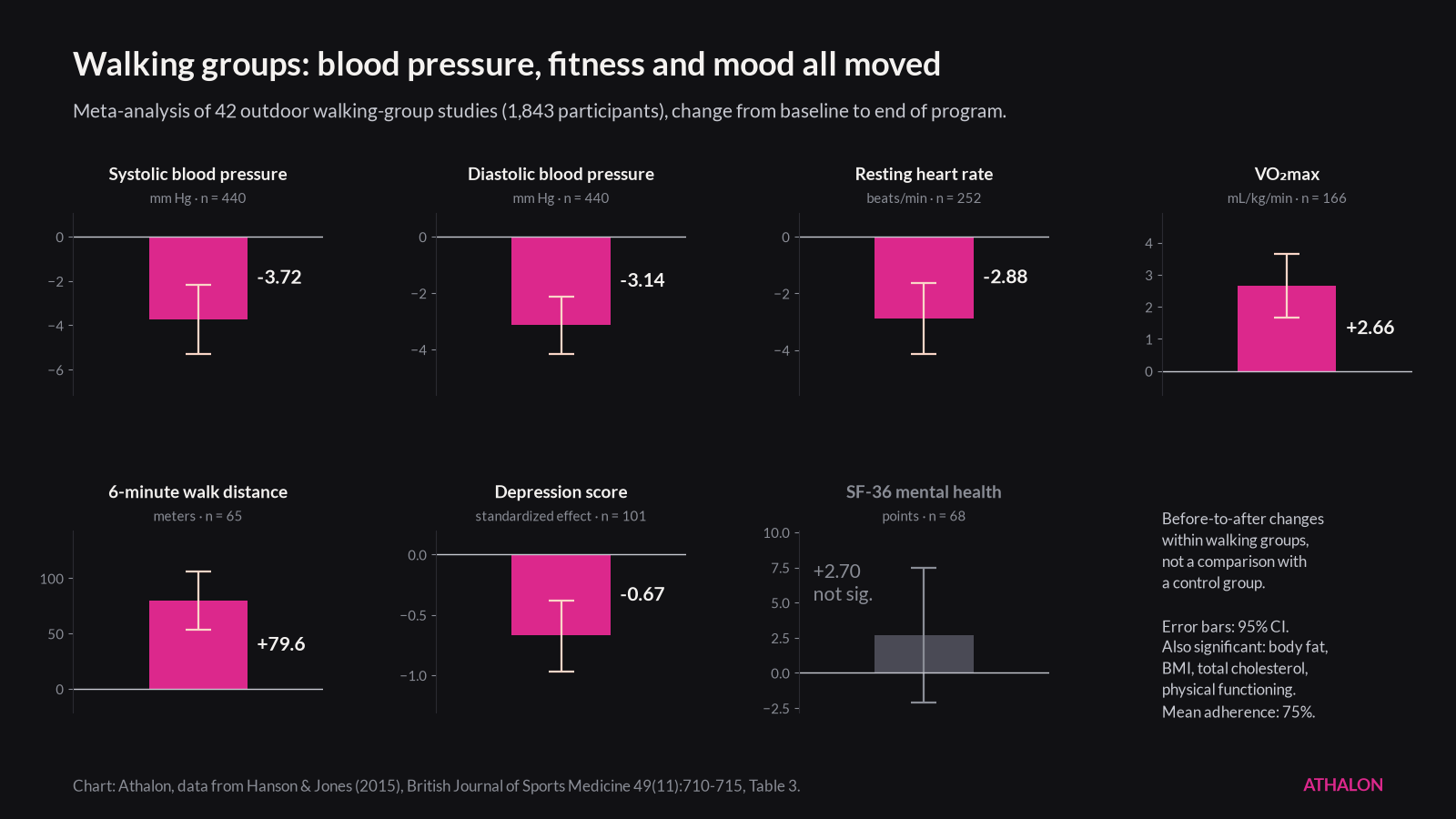
Chart: Athalon, data from Hanson & Jones (2015), British Journal of Sports Medicine, Table 3.
These are before-and-after changes, not comparisons with a control group, so some of the gain would likely have come from any new exercise routine.
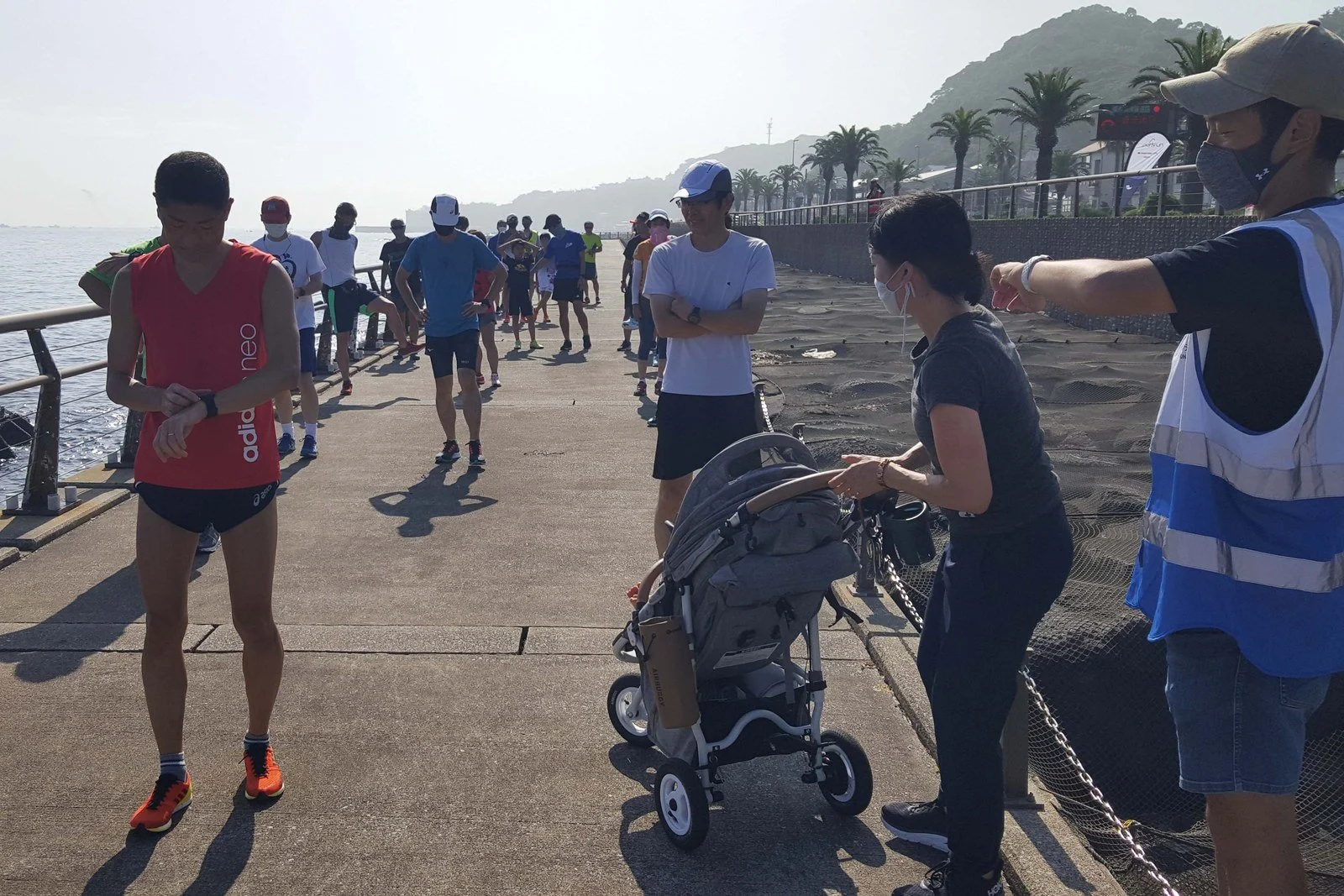
Photo: Yoshi Canopus / Wikimedia Commons, CC BY-SA 4.0 (cropped to 3:2 and resized). Runners and walkers, including a mother with her baby in a stroller, get ready for a 5 km parkrun on the Mabori Seacoast, Yokosuka, Japan, in July 2021. Athalon is not affiliated with parkrun.
Why Running With Others May Help You Keep Showing Up
If groups don't clearly beat solo training on average, why do so many people stick with run clubs? The parkrun research points to experience and identity. In a study of 143 parkrunners (734 surveys), social factors were associated with greater enjoyment and energy. Higher energy was linked to faster 5 km times without higher perceived effort, although social factors had no direct effect on run times (Davis et al., 2021).
Belonging matters too. Among 289 parkrunners, those who identified more strongly with the group took part more often and reported more exercise satisfaction, group cohesion and life satisfaction (Stevens et al., 2019). In a six-month study of 548 newly registered parkrunners, life satisfaction rose from 7.489 to 7.746 on a 0–10 scale. The least active newcomers gained the most, from 6.626 to 7.389 (Haake et al., 2024).
Group classes show a similar signal. In a small non-randomized study of 69 medical students, those taking weekly group fitness classes reported lower stress and better quality of life after 12 weeks, while students exercising alone or with up to two partners showed no significant change except in mental quality of life (Yorks et al., 2017).
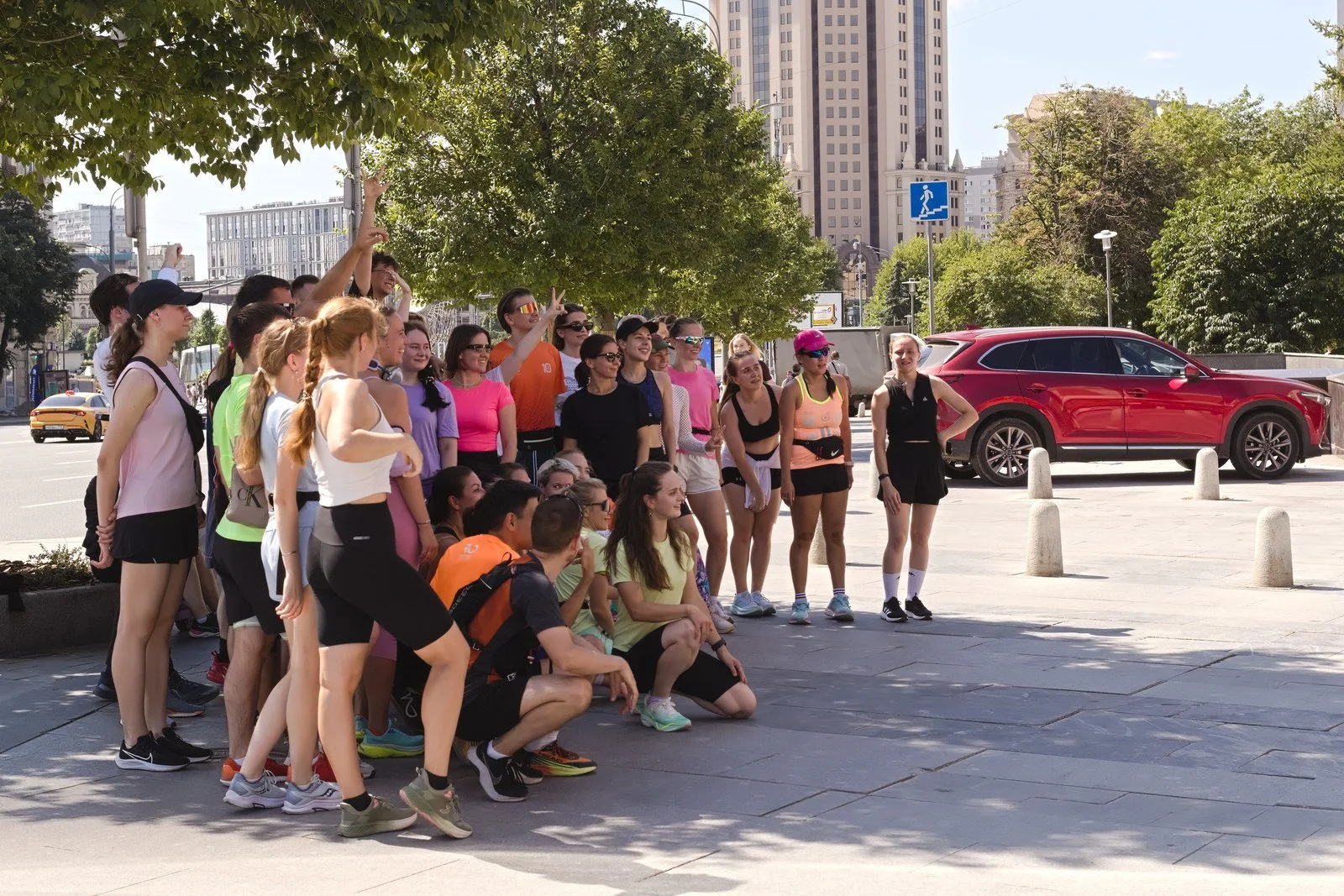
Photo: Retired electrician / Wikimedia Commons, CC0 1.0 public domain dedication (cropped to 3:2 and resized). A group of city runners stops to pose for a group photograph on Zatsepsky Val in Moscow, August 2026, as described by the photographer.
The Social Connection Side of Exercise
Social ties matter for health on their own. A meta-analysis of 148 studies (308,849 participants) found that people with stronger social relationships had a 50% increased likelihood of survival (Holt-Lunstad et al., 2010). WHO estimates that loneliness is linked to more than 871,000 deaths a year (WHO, 2025).
No study has tested whether joining a run club reduces mortality through social connection. Combining the two is a reasonable inference, not a tested effect.
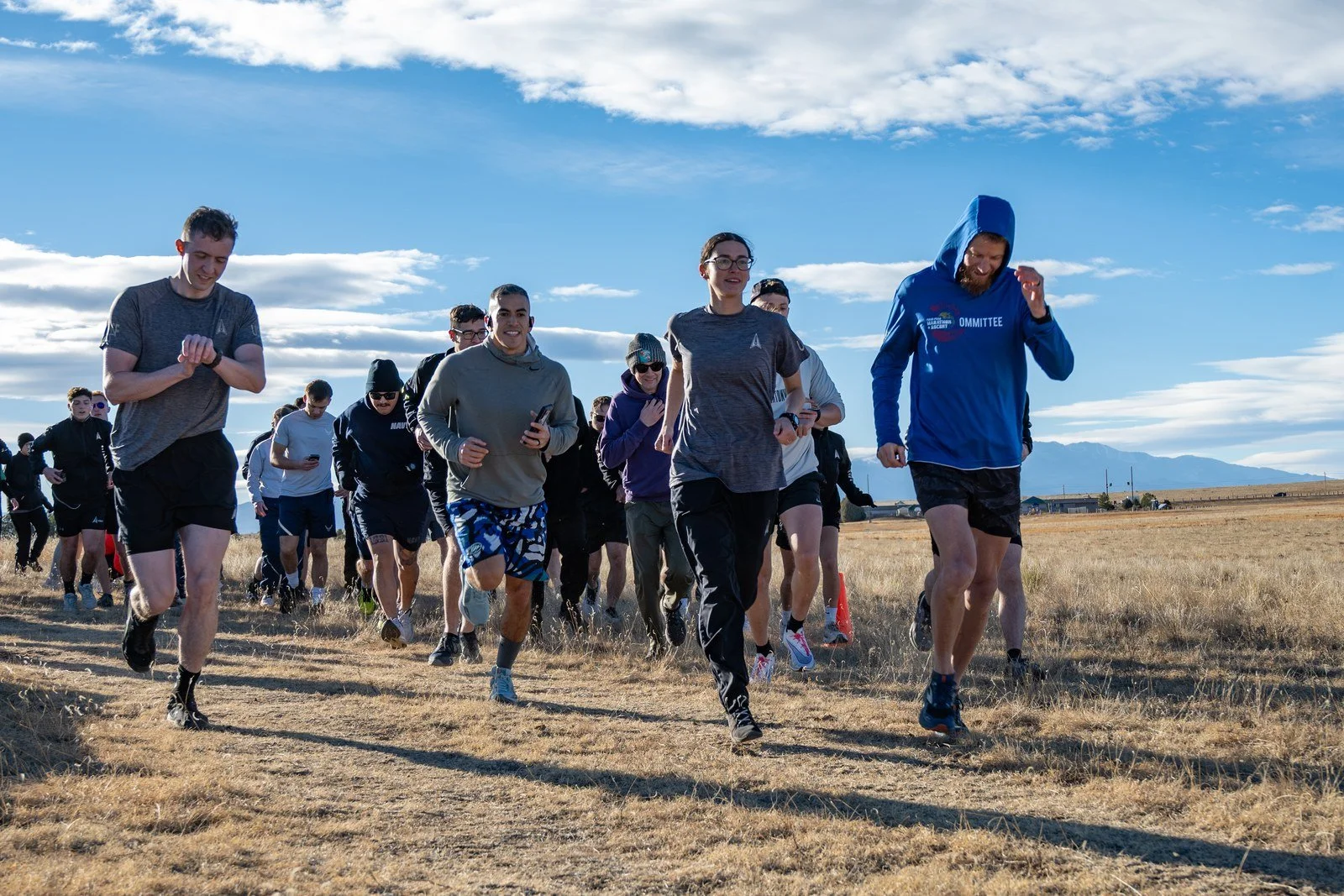
Photo: U.S. Space Force photo by Tiana Williams / DVIDS via Wikimedia Commons, public domain (cropped to 3:2 and resized). Guardians and Airmen start an annual holiday jog at Schriever Space Force Base, Colorado, in December 2025. Use of U.S. military imagery does not imply DoD endorsement.
How to Get the Most From a Run Club, Based on the Evidence
Pick the group you will actually attend. Group and solo programs had equivalent effects on activity, so choose the format that fits your life (meta-analysis conclusion) (Kritz et al., 2026).
Start with once a week. Even weekly running was linked to lower mortality (observational), and WHO says any amount of activity is better than none (Pedisic et al., 2020; WHO, 2026).
Look for a group with a leader and structure. Group programs led by trained exercise instructors showed larger activity effects than those led by health professionals, though walking groups led by lay people did as well as professionally led ones, so the evidence is mixed (Kritz et al., 2026; Kassavou et al., 2013).
Talk before and after the run. Social interaction was linked to enjoyment and energy at parkrun (observational, not tested as an intervention) (Davis et al., 2021).
Keep most group runs conversational. Running at a pace that lets you chat is an inference from the social findings above, not a tested protocol; our Zone 2 post covers easy-pace training.
Build toward the weekly target. One club run is a start; WHO's benchmark is at least 150 minutes of moderate activity per week (WHO, 2026).
Limitations
Much of this evidence is observational or uncontrolled. A systematic review of parkrun research found only "limited evidence from pre-post measure single-group prospective studies" (Peterson et al., 2022). All three authors of the parkrun life-satisfaction study are parkrunners and members of the parkrun Research Board, and their study had no control group (Haake et al., 2024). In the group-versus-individual meta-analysis, certainty was moderate for activity, function and health but low for psychosocial outcomes (Kritz et al., 2026). This is not medical advice. If you have a heart condition, chest pain or a recent injury, talk to a qualified clinician before starting a running program.
Conclusion: Show Up, Then Keep Showing Up
Running is one of the best-supported habits you can build, even at a low dose. Groups are not a shortcut: on average, they work about as well as training alone.
What a good run club adds is a reason to come back: a set time, people who expect you, and a run you enjoy. If that is what keeps you consistent, it is worth joining.
Bring your crew with you. In the Athalon app you can log your runs and lifts, create competitions with friends and see where everyone stands on the leaderboard between club nights. Download Athalon on the App Store.
Frequently Asked Questions
Q: Is running in a group better than running alone?
A: Not clearly. A 2026 meta-analysis of 71 studies found group and individual programs produced statistically equivalent changes in physical activity, so the best choice is the one you will stick with (Kritz et al., 2026).
Q: What are the mental health benefits of a run club?
A: Walking-group programs improved depression scores (Hanson & Jones, 2015), and stronger identification with a parkrun group was associated with higher life satisfaction (Stevens et al., 2019). Run clubs themselves have not been tested in randomized trials.
Q: How often do I need to run to benefit?
A: In a meta-analysis of large cohorts, any amount of running, even once a week, was associated with lower mortality than no running (Pedisic et al., 2020).
Q: I'm not a fast runner. Will I fit in at a run club?
A: Many groups welcome walkers. In one parkrun study, the least active newcomers had the largest rise in life satisfaction after six months, though the study had no control group (Haake et al., 2024).
References
American College of Sports Medicine. (2026, October 20). Wearables hold top spot in ACSM's 2027 fitness trends. https://acsm.org/2027-fitness-trends/
Davis, A. J., MacCarron, P., & Cohen, E. (2021). Social reward and support effects on exercise experiences and performance: Evidence from parkrun. PLOS ONE, 16(9), e0256546. https://doi.org/10.1371/journal.pone.0256546
Haake, S., Quirk, H., & Bullas, A. (2024). The impact of parkrun on life satisfaction and its cost-effectiveness: A six-month study of parkrunners in the United Kingdom. PLOS Global Public Health, 4(10), e0003580. https://doi.org/10.1371/journal.pgph.0003580
Hanson, S., & Jones, A. (2015). Is there evidence that walking groups have health benefits? A systematic review and meta-analysis. British Journal of Sports Medicine, 49(11), 710–715. https://doi.org/10.1136/bjsports-2014-094157
Holt-Lunstad, J., Smith, T. B., & Layton, J. B. (2010). Social relationships and mortality risk: A meta-analytic review. PLoS Medicine, 7(7), e1000316. https://doi.org/10.1371/journal.pmed.1000316
Kassavou, A., Turner, A., & French, D. P. (2013). Do interventions to promote walking in groups increase physical activity? A meta-analysis. International Journal of Behavioral Nutrition and Physical Activity, 10, 18. https://doi.org/10.1186/1479-5868-10-18
Kritz, M., Riddell, H., Olsen, D., Harden, S. M., Burke, S. M., Ntoumanis, N., & Thøgersen-Ntoumani, C. (2026). Individual versus group-based interventions: A systematic review and meta-analysis of physical activity, functional, psychosocial and health outcomes. Nature Human Behaviour, 10(6), 1109–1121. https://doi.org/10.1038/s41562-026-02429-0
Pedisic, Z., Shrestha, N., Kovalchik, S., Stamatakis, E., Liangruenrom, N., Grgic, J., Titze, S., Biddle, S. J. H., Bauman, A. E., & Oja, P. (2020). Is running associated with a lower risk of all-cause, cardiovascular and cancer mortality, and is the more the better? A systematic review and meta-analysis. British Journal of Sports Medicine, 54(15), 898–905. https://doi.org/10.1136/bjsports-2018-100493
Peterson, B., Withers, B., Hawke, F., Spink, M., Callister, R., & Chuter, V. (2022). Outcomes of participation in parkrun, and factors influencing why and how often individuals participate: A systematic review of quantitative studies. Journal of Sports Sciences, 40(13), 1486–1499. https://doi.org/10.1080/02640414.2022.2086522
Stevens, M., Rees, T., & Polman, R. (2019). Social identification, exercise participation, and positive exercise experiences: Evidence from parkrun. Journal of Sports Sciences, 37(2), 221–228. https://doi.org/10.1080/02640414.2018.1489360
World Health Organization. (2025, June 30). Social connection linked to improved health and reduced risk of early death [News release]. https://www.who.int/news/item/30-06-2025-social-connection-linked-to-improved-heath-and-reduced-risk-of-early-death
World Health Organization. (2026). Physical activity [Fact sheet]. https://www.who.int/news-room/fact-sheets/detail/physical-activity
Yorks, D. M., Frothingham, C. A., & Schuenke, M. D. (2017). Effects of group fitness classes on stress and quality of life of medical students. Journal of the American Osteopathic Association, 117(11), e17–e25. https://doi.org/10.7556/jaoa.2017.140
