Stop Foam Rolling Your IT Band: Why You Are Making Your Knee Pain Worse
Key Takeaways:
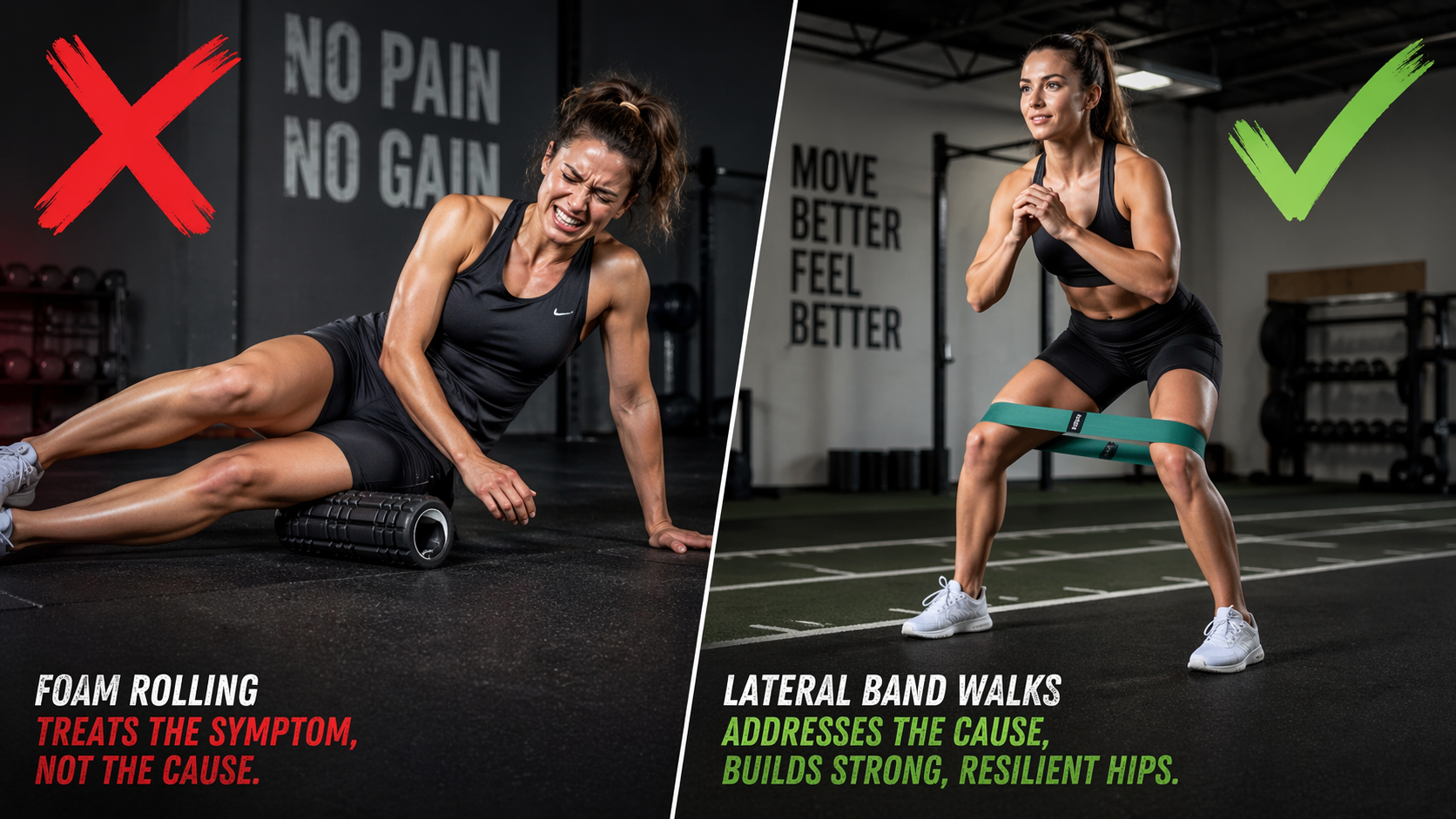
The Misunderstanding: Millions of runners and lifters try to cure outer knee pain by aggressively foam rolling the side of their leg.
The Biology: The Iliotibial (IT) Band is not a muscle; it is a massive piece of connective tissue with the tensile strength of Kevlar. You cannot "release" or stretch it.
The Danger: Smashing your IT band with a foam roller compresses a highly sensitive fat pad and bursa sac near the knee, triggering more inflammation and pain.
The True Fix: Your IT band isn't tight; it's being pulled taut to compensate for a weak Gluteus Medius. To fix the knee, you have to activate the side of the hip.
If you have ever experienced a sharp, stabbing pain on the outside of your knee during a run or after a heavy set of squats, you have likely been diagnosed with Iliotibial (IT) Band Syndrome.
The advice from the fitness industry is almost always identical: “Your IT band is tight. You need to get on a foam roller and roll it out.”
So, you lie sideways on a dense piece of foam, grit your teeth, and roll back and forth. It is excruciatingly painful. It feels like you are bruising the bone. You assume the pain means it’s working—that you are "breaking up scar tissue" and "lengthening the fascia."
But what if the pain doesn't mean it’s working? What if the pain means you are actively destroying the sensitive tissue around your knee?
Modern biomechanics has completely debunked the idea of rolling out the IT band. If you want to finally cure your knee pain, you need to throw the foam roller away and look at your hips.
The Anatomy of a Kevlar Cable

To understand why foam rolling is a massive waste of time, you have to understand what the IT band actually is.
It is not a muscle. Muscles are pliable; they contract, relax, and stretch. The IT band is a thick, dense layer of connective tissue (fascia) that runs from the top of your pelvis, down the outside of your thigh, and attaches just below your knee.
Its primary job is to act like a giant biological spring, storing and releasing energy as you walk and run, while stabilizing the knee joint.
Because it has to stabilize the entire weight of your body, it is incredibly tough. In fact, a famous biomechanical study published in the Journal of the American Osteopathic Association found that it requires over 2,000 pounds of force to stretch the IT band by just 1%. You cannot stretch it. You cannot lengthen it. And your 180-pound body weight on a piece of foam is absolutely not "breaking up scar tissue."
Why Foam Rolling Causes More Pain
If you can't stretch it, what are you actually doing when you foam roll the side of your leg?
You are crushing the tissue directly beneath it.
Where the IT band crosses the outside of your knee, there is a highly sensitive structure called a bursa sac, as well as a highly innervated layer of fat. When the IT band becomes irritated, these tissues become wildly inflamed.
When you take a hard plastic roller and repeatedly smash your body weight into that inflamed tissue, you are literally crushing an already bruised bursa against your femur. The extreme pain you feel isn't "weakness leaving the body"—it is your nervous system screaming at you to stop causing localized trauma.
The Real Culprit: The Lazy Hip
If the IT band isn't the problem, why does it feel so tight?
The IT band is essentially a puppet string. If the string is pulled dangerously tight, you don't blame the string—you blame the muscle pulling it. The two main muscles that feed into the top of the IT band are the Tensor Fasciae Latae (TFL) in the front of the hip, and the Gluteus Medius on the side of the hip.
The Gluteus Medius is your primary pelvic stabilizer. When you run, walk, or balance on one leg, the Glute Medius fires to keep your hips level. However, because modern humans sit in chairs all day, our glutes become neurologically "lazy" (a condition Dr. Stuart McGill refers to as Gluteal Amnesia).
When your Glute Medius forgets how to fire, your body panics. It needs stability to keep you from falling over, so it recruits the TFL muscle to do all the heavy lifting. The TFL pulls aggressively on the IT band, yanking it incredibly tight, and causing it to grind against the outside of your knee.
The "tightness" in your leg is just a symptom. The weakness in your hip is the disease.
The Athalon Fix: The Lateral Glute Protocol
To cure IT Band Syndrome, you have to take the mechanical load off the knee and put it back onto the glutes where it belongs .Instead of torturing yourself on a foam roller, dedicate 5 minutes before your workout to these two highly targeted Glute Medius activation exercises:
1. The Clamshell (The Isolator)
How: Lie on your side with your knees bent at a 45-degree angle, with a resistance band looped around your thighs (just above the knees). Keep your feet touching, and slowly raise your top knee as high as you can without rotating your lower back.
The Focus: You should feel an intense burn in the upper, outer corner of your glute—not the front of your hip.
Volume: 3 sets of 15 slow reps per side.
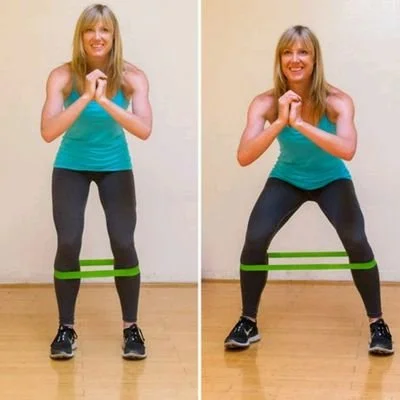
2. The Lateral Band Walk (The Integrator)
How: Place a resistance band around your ankles. Drop into a quarter-squat athletic stance. Keep your chest up and take 10 slow, controlled steps to the right, then 10 steps to the left.
The Focus: Do not let your trailing foot drag, and do not let your knees cave inward. Force your hips to do the work.
Volume: 3 sets of 20 steps per direction.
@skimble
Conclusion: Treat the Cause, Not the Symptom
The fitness industry has conditioned us to chase the site of the pain. If the knee hurts, we attack the knee. But the human body operates as a connected kinetic chain. In almost all biomechanical injuries, the joint that hurts is just the victim of a lazy joint somewhere else. Your knee is crying out for help because your hip is asleep on the job.
Throw away the foam roller. Grab a resistance band. Wake up your glutes, and take your knees back.
Frequently Asked Questions (FAQ)
Q: Should I stop foam rolling altogether? A: No. Foam rolling is excellent for neurologically relaxing large, meaty muscles like the quads, calves, and lats. It stimulates blood flow and down-regulates the nervous system. But you should never aggressively roll over dense tendons, ligaments, or the IT band.
Q: Is it okay to stretch the muscles around the IT band? A: Yes! While you can't stretch the IT band itself, you can stretch the muscles attached to it. Stretching the TFL (the front of the hip) and the Glute Maximus can help alleviate the tension pulling on the band.
Q: How long does it take to fix IT Band pain? A: If you completely cease activities that aggravate it (like heavy running) and strictly adhere to daily Glute Medius strengthening, most athletes see significant pain reduction within 2 to 4 weeks.
Works Cited
Chaudhry, H., et al. (2008). Three-dimensional mathematical model for deformation of human fasciae in manual therapy. The Journal of the American Osteopathic Association, 108(8), 379-390.
Fredericson, M., et al. (2000). Hip abductor weakness in distance runners with iliotibial band syndrome. Clinical Journal of Sport Medicine, 10(3), 169-175.
Falvey, E. C., et al. (2010). Iliotibial band syndrome: an examination of the evidence behind a number of treatment options. Scandinavian Journal of Medicine & Science in Sports, 20(4), 580-587.
