
Photo: Nenad Stojkovic / Wikimedia Commons (from Flickr), CC BY 2.0 (trimmed to 3:2 and resized). A woman sets up for a barbell back squat in a gym.
Key Takeaways
Cardio did not blunt maximal strength or muscle size. Across 43 studies, adding aerobic training to a strength program made no meaningful difference to maximal strength or whole-muscle growth (Schumann et al., 2022).
Explosive strength is the exception. Jump and rapid-force gains were slightly smaller, mainly when both were done in the same session (Schumann et al., 2022).
Trained lifters doing both in one session saw the most interference. When sessions were more than 2 hours apart, there was no significant effect on leg strength (Petré et al., 2021).
Combining both gives you both. An umbrella review found concurrent training matched endurance-only training for aerobic capacity and beat it for strength (Held et al., 2026).
Hybrid training means lifting and doing endurance work in the same program, the kind of preparation that mixed events such as HYROX, which combine running with strength stations, call for (see our HYROX post). Health guidelines already ask for both: the World Health Organization recommends 150–300 minutes of moderate aerobic activity a week plus muscle-strengthening activities on 2 or more days (Bull et al., 2020).
The old worry is the "interference effect": the idea that cardio blunts strength and muscle gains. Our HYROX post touched on a 2012 meta-analysis of this question. This post covers the newer evidence: what interference looks like today, who it affects, and how to order and space your sessions.
What Is Hybrid (Concurrent) Training?
In research, hybrid training is called concurrent training: the combination of resistance training and endurance training (Held et al., 2026). The two can be done in the same session, on the same day or on different days. In the largest recent meta-analysis, each concurrent group was compared with a group doing the identical strength program and no aerobic training (Schumann et al., 2022). That design isolates what the extra endurance work costs, or doesn't.
Does Cardio Kill Your Gains? What the Newest Meta-Analyses Show
The largest recent analysis pooled 43 studies and 1,090 participants. Compared with strength training alone, concurrent training made no meaningful difference to maximal strength (standardized mean difference, SMD −0.06) or whole-muscle hypertrophy (SMD −0.01). Explosive strength, such as jump height, was the one outcome that took a small hit (SMD −0.28) (Schumann et al., 2022).
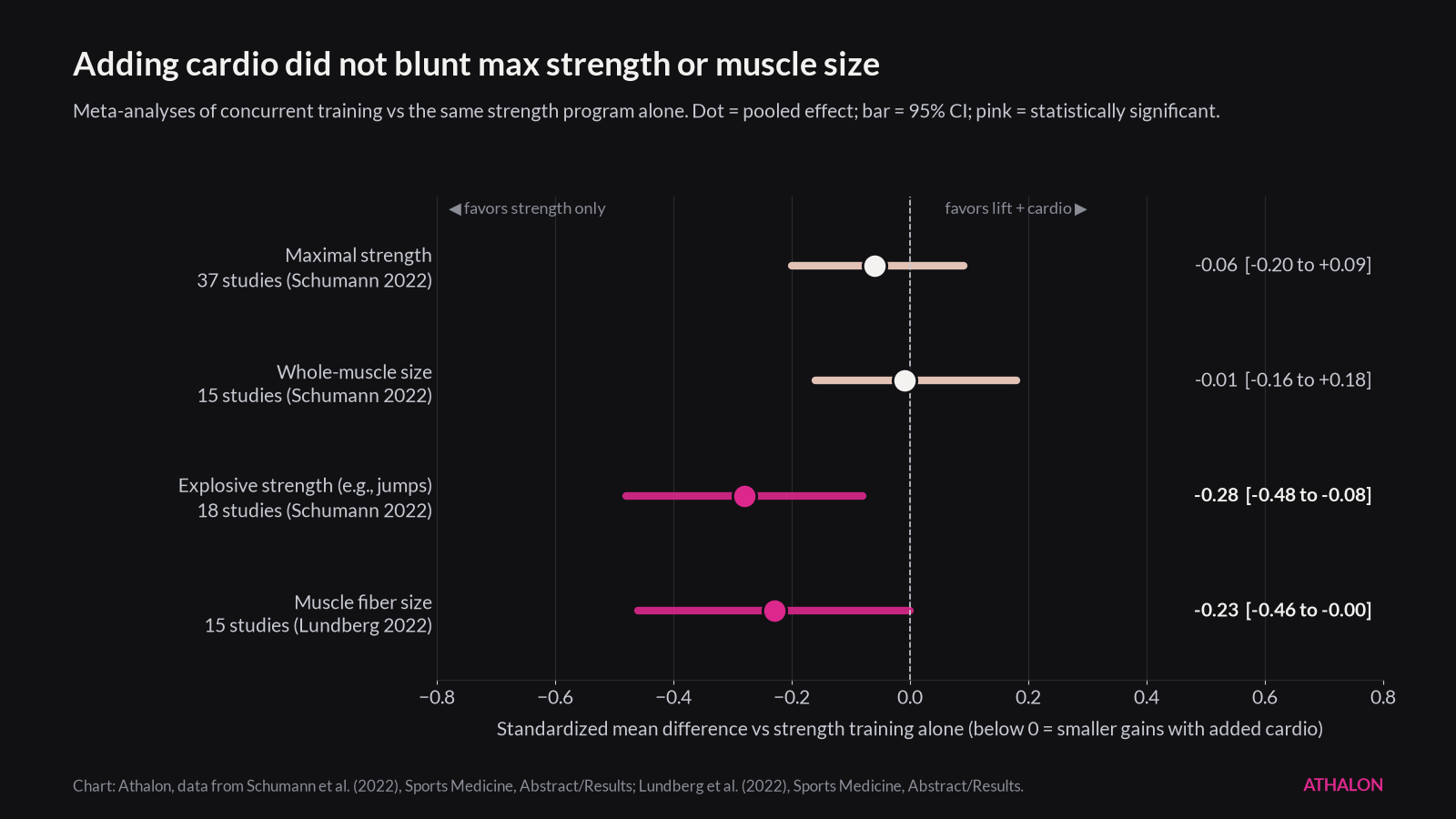
Chart: Athalon, data from Schumann et al. (2022), Sports Medicine, Abstract/Results; Lundberg et al. (2022), Sports Medicine, Abstract/Results.
The same group then looked under the microscope. Across 15 studies with muscle biopsies, concurrent training had a small negative effect on muscle fiber size (SMD −0.23), with a larger effect on type I fibers when the cardio was running rather than cycling. Only three of those studies used running, so the authors called this preliminary (Lundberg et al., 2022).
A 2026 umbrella review of 17 meta-analyses (144 studies, 1,492 healthy participants) reached a similar bottom line. Compared with strength training alone, concurrent training produced comparable strength, power and hypertrophy outcomes while improving aerobic capacity more (Held et al., 2026).
When the Interference Effect Shows Up
Averages can hide subgroups. A meta-analysis of 27 studies on leg press and squat 1RM split participants by training status. Concurrent training reduced strength gains in trained individuals (effect size −0.35) but not in untrained or moderately trained people. In trained people, the drop appeared only when strength and endurance work were done within 20 minutes of each other (−0.66), not when sessions were more than 2 hours apart (−0.10) (Petré et al., 2021).
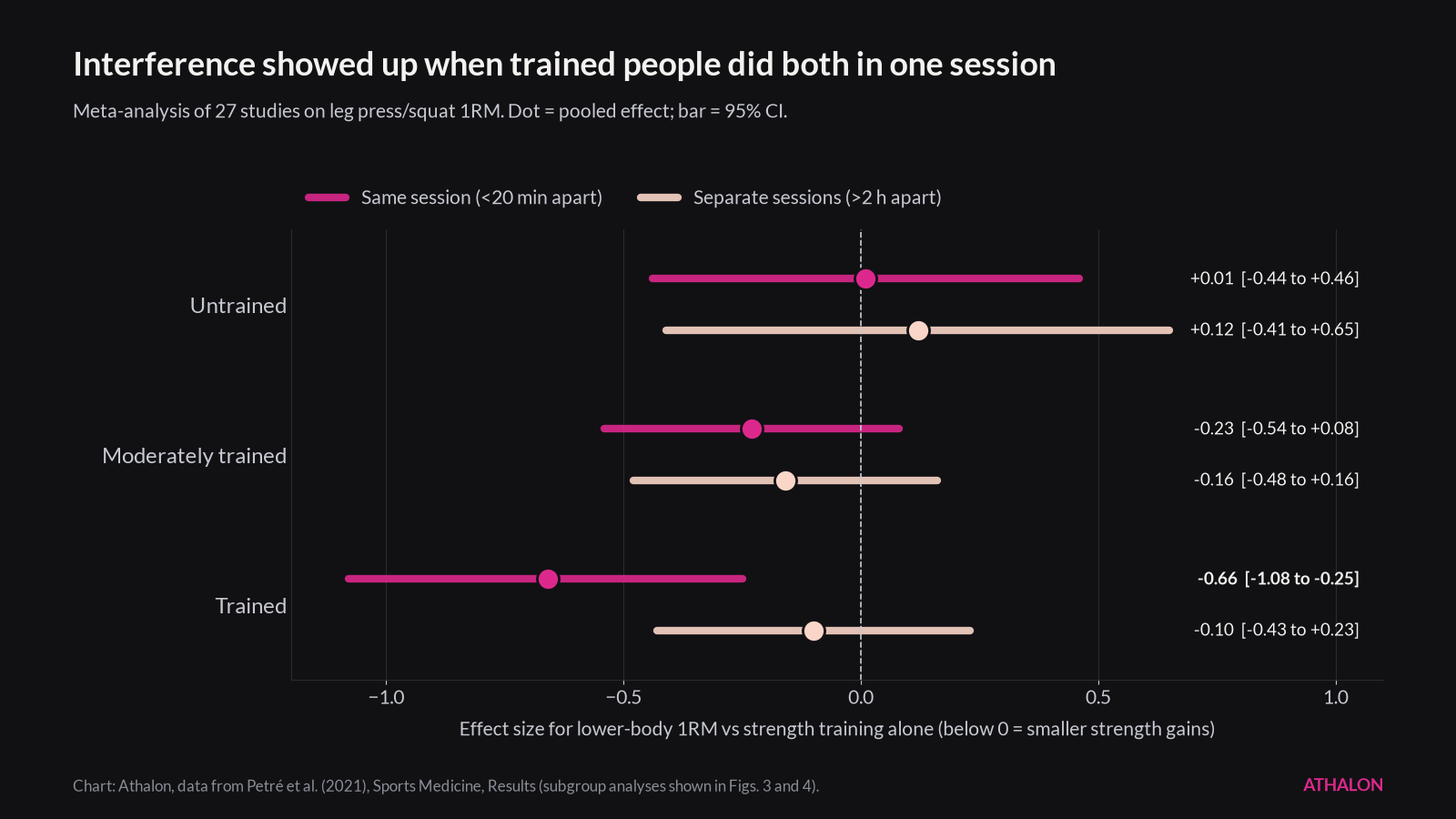
Chart: Athalon, data from Petré et al. (2021), Sports Medicine, Results (subgroup analyses shown in Figs. 3 and 4).
Sex may matter too. A 2024 meta-analysis of 59 studies (1,346 adults aged 18–50) found blunted lower-body strength gains with concurrent training in men (SMD −0.43) but not in women (0.08). Power gains were impaired in both sexes. The authors noted that more of the studies involved men, so the conclusions for women rest on fewer studies (Huiberts et al., 2024).
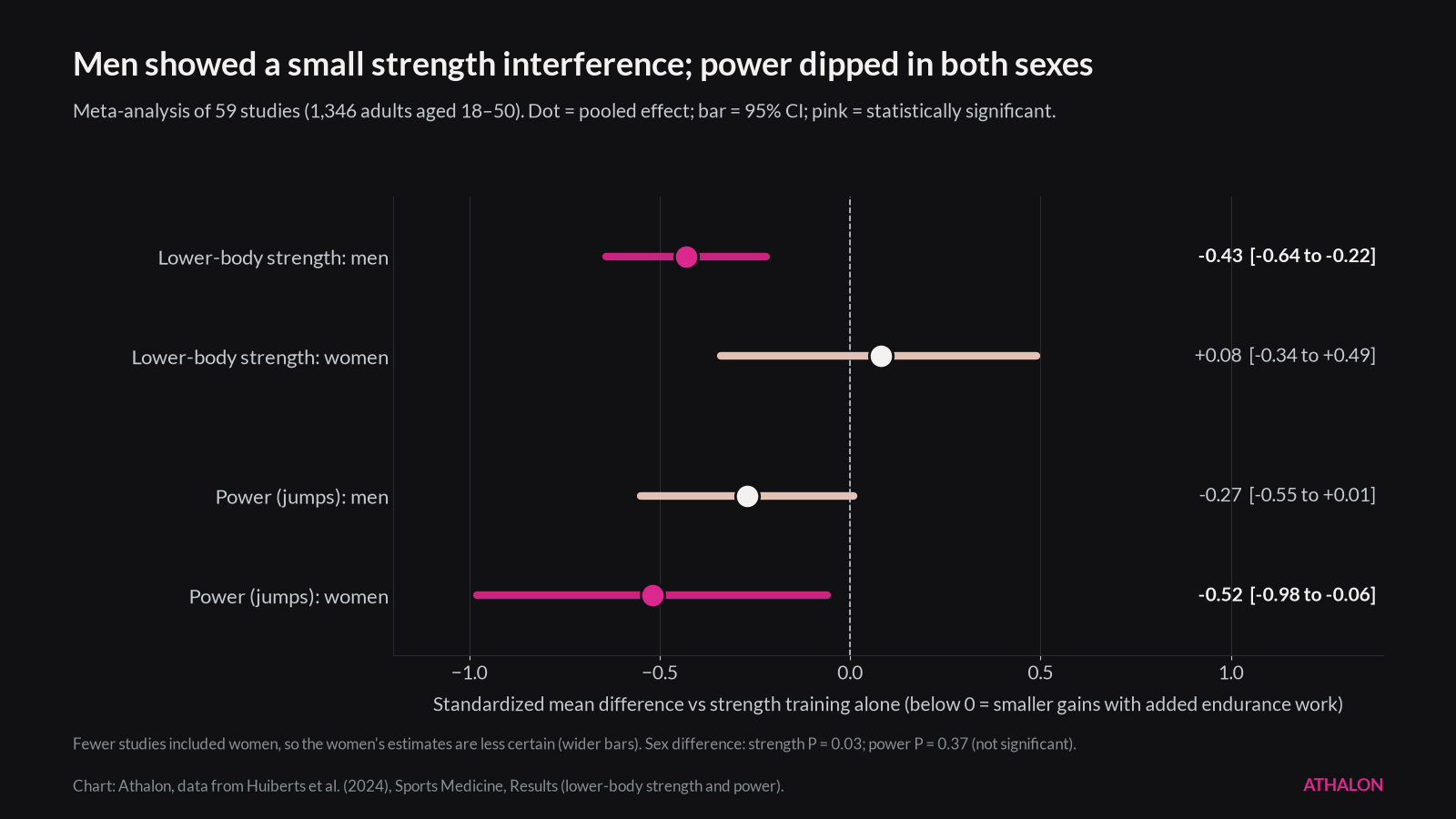
Chart: Athalon, data from Huiberts et al. (2024), Sports Medicine, Results (lower-body strength and power).
Does Lifting Hurt Your Endurance?
Mostly not. The umbrella review found comparable gains in aerobic capacity for concurrent and endurance-only training (Held et al., 2026). One caveat: untrained people, but not trained or highly trained endurance athletes, showed smaller VO₂max gains with concurrent training (Huiberts et al., 2024).
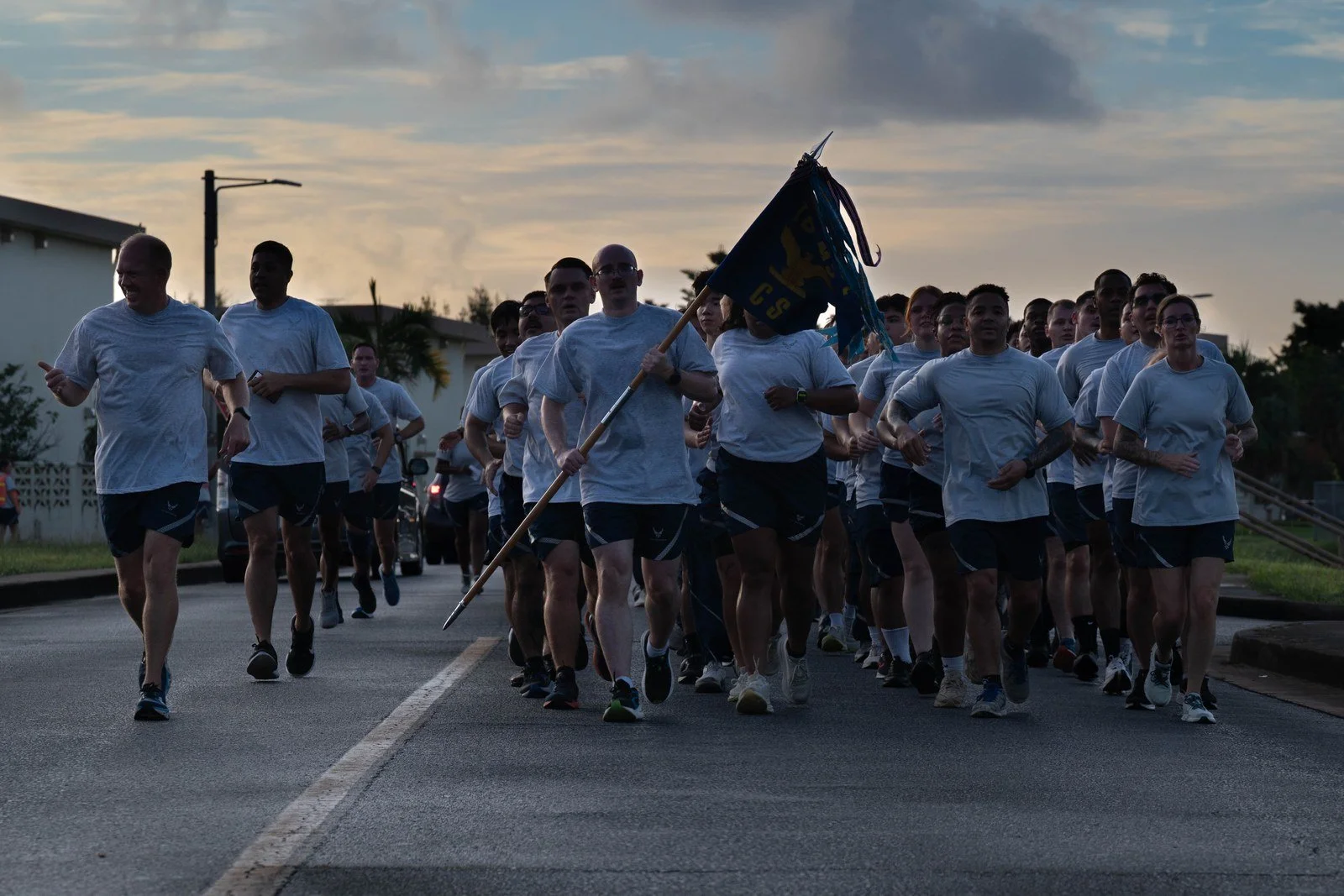
Photo: Senior Airman Jamal J. Berry II, U.S. Air Force / Wikimedia Commons (from DVIDS), public domain (cropped to 3:2 and resized). Airmen of the 18th Communications Squadron on a two-mile morale run at Kadena Air Base, Japan, October 2025. Use of U.S. military imagery does not imply DoD endorsement.
Strength work can also help runners. In a meta-analysis of 22 studies of long-distance runners, adding heavy resistance training improved running economy, the oxygen cost of running at a given speed, by a small amount (g −0.32), and loads of at least 90% of 1RM worked better than lighter loads (Eihara et al., 2022).
The type of cardio may matter as well. In nine trials (177 participants), adding sprint interval training to resistance training did not reduce strength or jump gains, and it improved VO₂max compared with resistance training alone (Ferraro-Farro et al., 2026).
Lift or Run First? Order and Spacing
When both happen in one session, order seems to matter a little. A meta-analysis of 19 randomized trials found that strength-then-endurance produced slightly larger lower-limb strength gains than the reverse (SMD 0.19), with no difference in VO₂max (Gao & Yu, 2023). The 2026 umbrella review found no significant sequence effects overall, though lifting first trended toward better strength and hypertrophy (Held et al., 2026).
Spacing looks more important than order. The explosive-strength penalty appeared when sessions were 20 minutes or less apart, but not when they were separated by at least 3 hours (Schumann et al., 2022). The same pattern held for trained lifters' leg strength (Petré et al., 2021).
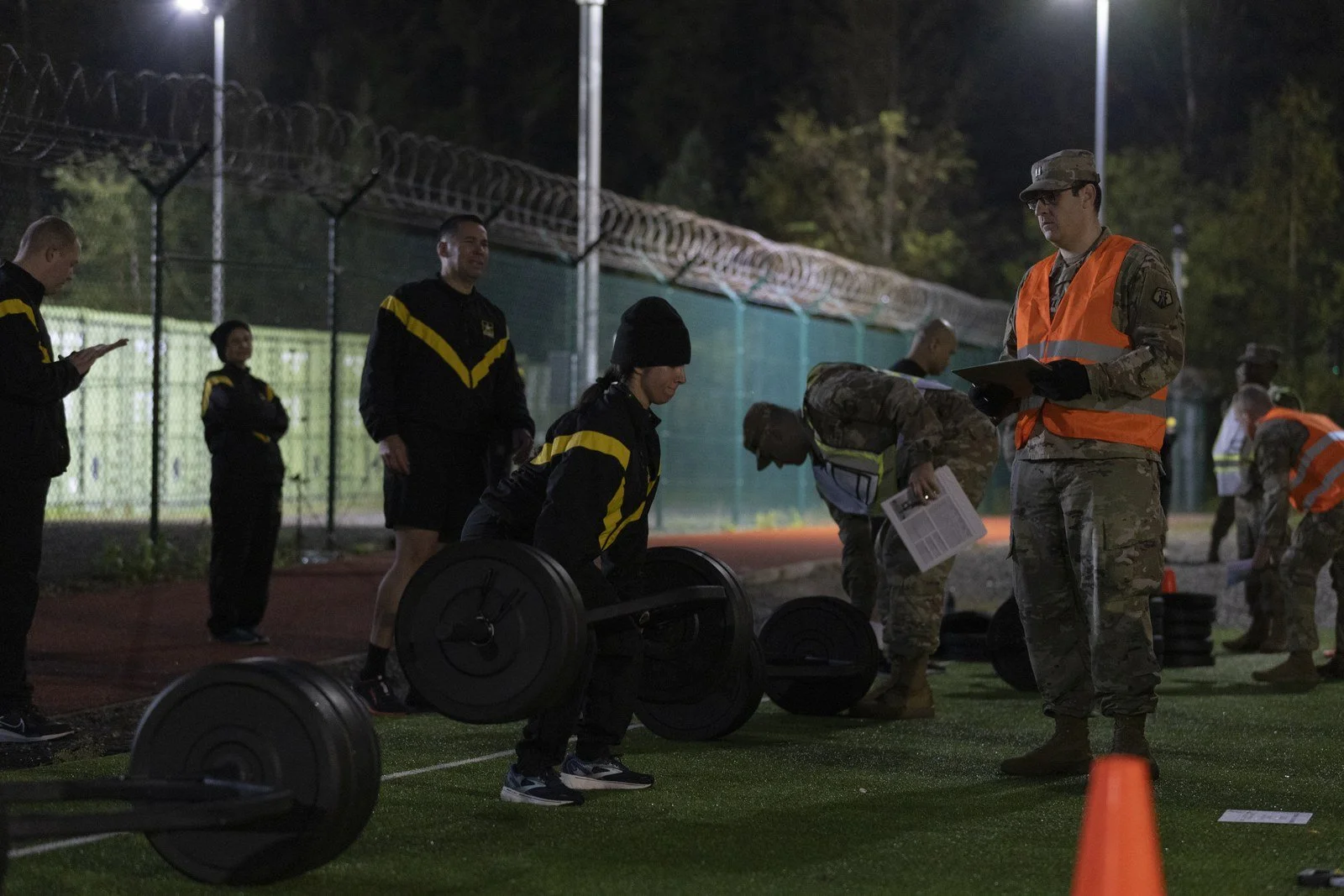
Photo: Staff Sgt. Logan Swift, U.S. Army Reserve / Wikimedia Commons (from DVIDS), public domain (resized). Army Reserve Soldiers perform a three-repetition maximum deadlift during the Army Combat Fitness Test in Kaiserslautern, Germany, October 2024. Use of U.S. military imagery does not imply DoD endorsement.
For adults aged 50 to 73, concurrent training improved strength, power and cardiorespiratory endurance compared with no training. Strength gains were largest when strength came before endurance in the same session (Markov et al., 2023).
How to Program Hybrid Training, Based on the Evidence
Do both. Concurrent training did not reduce maximal strength or whole-muscle growth on average (meta-analysis) (Schumann et al., 2022).
Separate hard lifting and hard cardio when you can. Sessions more than 2–3 hours apart avoided the measured interference (meta-analyses) (Petré et al., 2021; Schumann et al., 2022).
If it's one session, lift first when strength is the priority. The advantage was small (meta-analysis) (Gao & Yu, 2023).
Protect power work. If jumping or sprinting matters for your sport, keep explosive work away from endurance sessions. This is our inference from the explosive-strength results (Schumann et al., 2022).
Consider cycling or sprint intervals in heavy lifting blocks. Running showed more fiber-level interference in a small number of studies, and sprint intervals did not blunt strength (preliminary) (Lundberg et al., 2022; Ferraro-Farro et al., 2026).
Runners: lift heavy. Loads of at least 90% of 1RM improved running economy most (meta-analysis) (Eihara et al., 2022).
For a sample weekly structure that mixes strength and conditioning, see our bodybuilding vs functional fitness post.
Limitations
Most studies were short (under 12 weeks) with small groups (Petré et al., 2021), and the average methodological quality in the largest analysis was rated medium (Schumann et al., 2022). Women and highly trained athletes are underrepresented (Huiberts et al., 2024; Held et al., 2026). Effects are averages; your response may differ. If you have a medical condition or injury, talk to a qualified clinician before adding training volume.
Conclusion: Train Both, Space Them Smartly
For most people, hybrid training is not a trade-off. You can build strength, muscle and aerobic fitness in the same program, and the measured interference is small and specific: power, and leg strength in trained lifters who stack both into one session.
If strength is your priority, give hard lifting its own session or lift first. If endurance is your priority, heavy strength work can make you a more economical runner.
Train both, and track both. In the Athalon app you can log your lifts and your runs in one place, create competitions with friends and see where everyone stands on the leaderboard. Download Athalon on the App Store.
Frequently Asked Questions
Q: Does cardio kill muscle gains?
A: Not on average. In 43 studies, adding aerobic training did not reduce maximal strength or whole-muscle growth, though explosive strength gains were slightly smaller (Schumann et al., 2022).
Q: Should I lift or run first?
A: If strength is the priority, lift first. Strength-then-endurance produced slightly larger lower-limb strength gains with no difference in VO₂max (Gao & Yu, 2023).
Q: How far apart should I space lifting and cardio?
A: More than 2 hours if you can. Trained lifters had smaller leg strength gains only when the sessions were within 20 minutes of each other (Petré et al., 2021).
Q: Will lifting make me a slower runner?
A: The evidence points the other way. Heavy resistance training improved running economy in long-distance runners (Eihara et al., 2022).
References
Bull, F. C., Al-Ansari, S. S., Biddle, S., Borodulin, K., Buman, M. P., Cardon, G., Carty, C., Chaput, J.-P., Chastin, S., Chou, R., Dempsey, P. C., DiPietro, L., Ekelund, U., Firth, J., Friedenreich, C. M., Garcia, L., Gichu, M., Jago, R., Katzmarzyk, P. T., … Willumsen, J. F. (2020). World Health Organization 2020 guidelines on physical activity and sedentary behaviour. British Journal of Sports Medicine, 54(24), 1451–1462. https://doi.org/10.1136/bjsports-2020-102955
Eihara, Y., Takao, K., Sugiyama, T., Maeo, S., Terada, M., Kanehisa, H., & Isaka, T. (2022). Heavy resistance training versus plyometric training for improving running economy and running time trial performance: A systematic review and meta-analysis. Sports Medicine – Open, 8, 138. https://doi.org/10.1186/s40798-022-00511-1
Ferraro-Farro, D., Bandeira-Guimarães, M., Blanco-Rambo, E., Vieira, A. F., Cadore, E. L., & Benítez-Flores, S. (2026). Does sprint interval training cause interference in concurrent training? A meta-analysis study. International Journal of Sports Medicine, 47(10), 747–759. https://doi.org/10.1055/a-2820-4527
Gao, J., & Yu, L. (2023). Effects of concurrent training sequence on VO2max and lower limb strength performance: A systematic review and meta-analysis. Frontiers in Physiology, 14, 1072679. https://doi.org/10.3389/fphys.2023.1072679
Held, S., Wolf, L., Rappelt, L., Bloch, W., Donath, L., Micke, F., Geisler, S., & Isenmann, E. (2026). Maximizing adaptations in concurrent training: An umbrella review of meta-analyses. Sports Medicine, 56(6), 1489–1512. https://doi.org/10.1007/s40279-026-02401-y
Huiberts, R. O., Wüst, R. C. I., & van der Zwaard, S. (2024). Concurrent strength and endurance training: A systematic review and meta-analysis on the impact of sex and training status. Sports Medicine, 54(2), 485–503. https://doi.org/10.1007/s40279-023-01943-9
Lundberg, T. R., Feuerbacher, J. F., Sünkeler, M., & Schumann, M. (2022). The effects of concurrent aerobic and strength training on muscle fiber hypertrophy: A systematic review and meta-analysis. Sports Medicine, 52(10), 2391–2403. https://doi.org/10.1007/s40279-022-01688-x
Markov, A., Hauser, L., & Chaabene, H. (2023). Effects of concurrent strength and endurance training on measures of physical fitness in healthy middle-aged and older adults: A systematic review with meta-analysis. Sports Medicine, 53(2), 437–455. https://doi.org/10.1007/s40279-022-01764-2
Petré, H., Hemmingsson, E., Rosdahl, H., & Psilander, N. (2021). Development of maximal dynamic strength during concurrent resistance and endurance training in untrained, moderately trained, and trained individuals: A systematic review and meta-analysis. Sports Medicine, 51(5), 991–1010. https://doi.org/10.1007/s40279-021-01426-9
Schumann, M., Feuerbacher, J. F., Sünkeler, M., Freitag, N., Rønnestad, B. R., Doma, K., & Lundberg, T. R. (2022). Compatibility of concurrent aerobic and strength training for skeletal muscle size and function: An updated systematic review and meta-analysis. Sports Medicine, 52(3), 601–612. https://doi.org/10.1007/s40279-021-01587-7
