Photo: Shixart1985 / Wikimedia Commons, CC BY 2.0 (trimmed to 3:2 and resized). A woman exercises with light dumbbells on a mat in her living room.
Key Takeaways
Some lifting beats none. Muscle-strengthening activities were linked to a 10–17% lower risk of all-cause mortality, cardiovascular disease, total cancer, diabetes and lung cancer (Momma et al., 2022).
The benefit peaked at a modest dose. The largest risk reduction appeared at roughly 30–60 minutes a week, and more was not clearly better (Momma et al., 2022; Shailendra et al., 2022).
Lifting plus cardio had the lowest risk. Combining muscle-strengthening and aerobic activity was linked to a 40% lower risk of death from any cause (Momma et al., 2022).
These are associations, not proof. The mortality data come from observational studies, and the certainty of the evidence was rated generally very low (Momma et al., 2022).
Strength training for longevity is getting more attention. Traditional strength training rose two spots to No. 5 in the American College of Sports Medicine's 2027 fitness trends survey, and fitness programs for older adults ranked No. 4 (ACSM, 2026). ACSM also notes that a high trend ranking "does not establish that a particular product or program is effective" (ACSM, 2026).
So what does the evidence say? Guidelines already ask adults to do muscle-strengthening activities on 2 or more days a week (Bull et al., 2020). This post looks at a narrower question: how much lifting is linked to a longer life, and where the returns level off.
Why Muscle Matters as You Age
Aging, even without chronic disease, is associated with biological changes that can contribute to decreases in muscle mass, strength and function. The National Strength and Conditioning Association calls resistance training "a powerful intervention to combat the loss of muscle strength and muscle mass" in older adults (Fragala et al., 2019).
The training evidence is broad. ACSM's 2026 position stand, an overview of 137 systematic reviews with more than 30,000 participants, found that resistance training improved strength, muscle size, power, gait speed, balance and multiple measures of physical function compared with no exercise (Currier et al., 2026).
If you want a quick strength marker, our grip strength post covers how grip relates to health. This post focuses on the training itself.
Strength Training and Mortality: What the Meta-Analyses Show
A 2022 meta-analysis pooled 16 prospective cohort studies. Compared with doing none, any muscle-strengthening activity was linked to a 15% lower risk of death from any cause (relative risk 0.85), along with lower risk of cardiovascular disease, total cancer, diabetes and lung cancer (Momma et al., 2022).
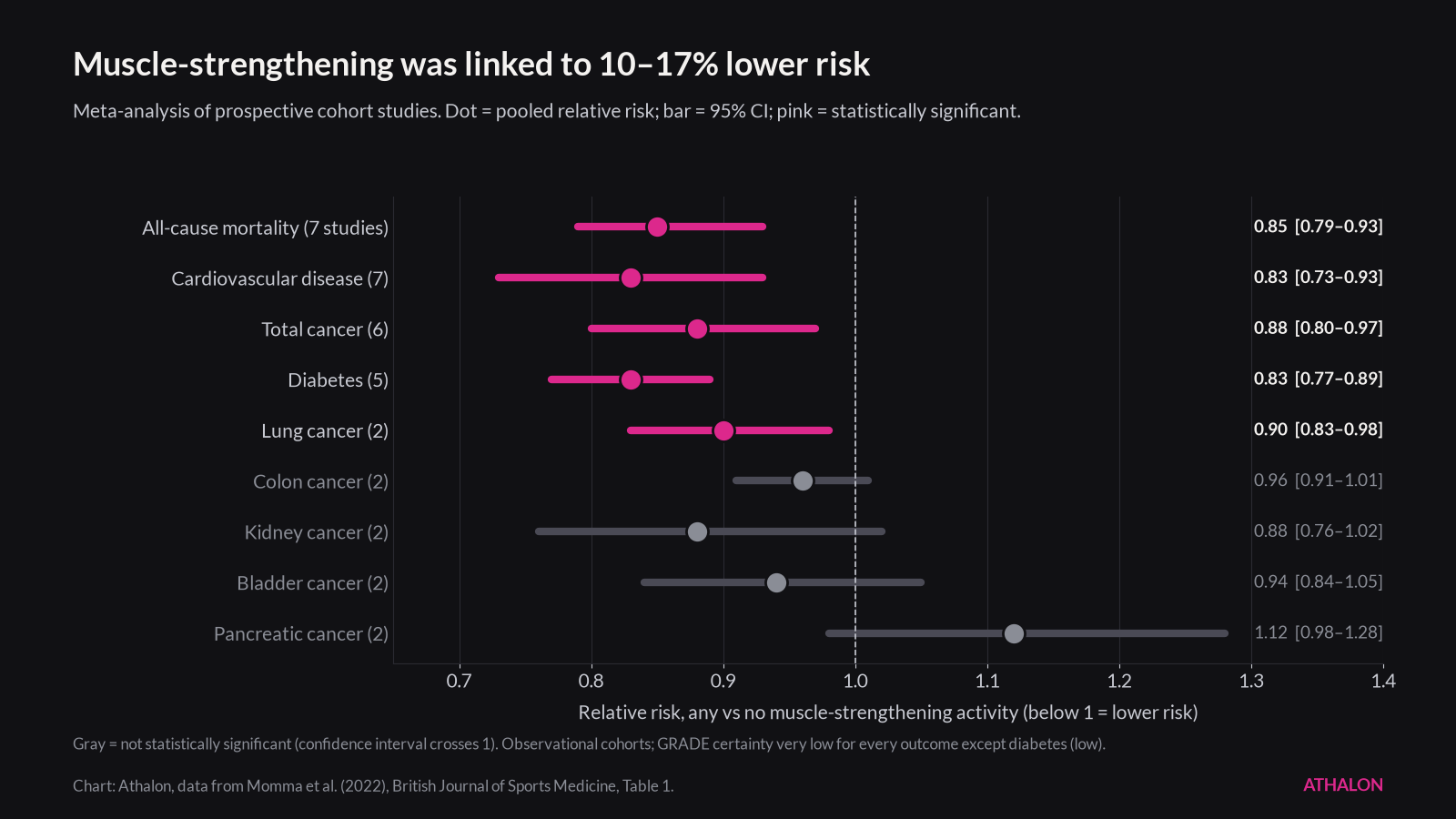
Chart: Athalon, data from Momma et al. (2022), British Journal of Sports Medicine, Table 1.
Not every outcome moved. The same review found no association with colon, kidney, bladder or pancreatic cancer (Momma et al., 2022).
Other reviews point the same way. A meta-analysis of 10 studies found that any resistance training was linked to a 15% lower risk of all-cause mortality, 19% lower cardiovascular mortality (a borderline estimate) and 14% lower cancer mortality (Shailendra et al., 2022). An earlier review of 11 studies (370,256 participants) found 21% lower all-cause mortality with resistance training alone (Saeidifard et al., 2019).
How Much Strength Training Is Enough?
This is where the data get interesting. In the dose-response analysis, the risk of death from any cause was lowest at about 40 minutes of muscle-strengthening activity a week (17% lower). Above that, the curve flattened and turned back up, a J-shape, though the estimated risk stayed below that of no training up to about 140 minutes a week (Momma et al., 2022).
A separate dose-response analysis of 4 studies found a maximum risk reduction of 27% at around 60 minutes a week, with smaller reductions at higher volumes (Shailendra et al., 2022).
Frequency data tell a similar story. In a U.S. cohort of 416,420 adults, muscle-strengthening once a week was linked to additional risk reduction (hazard ratio 0.89), while 7 times a week showed no clear benefit (0.99) (Coleman et al., 2022). In nearly 100,000 older adults, lifting 1–2 times a week was linked to 14% lower all-cause mortality after accounting for aerobic activity, while 3 or more times a week showed a smaller association (Gorzelitz et al., 2022).
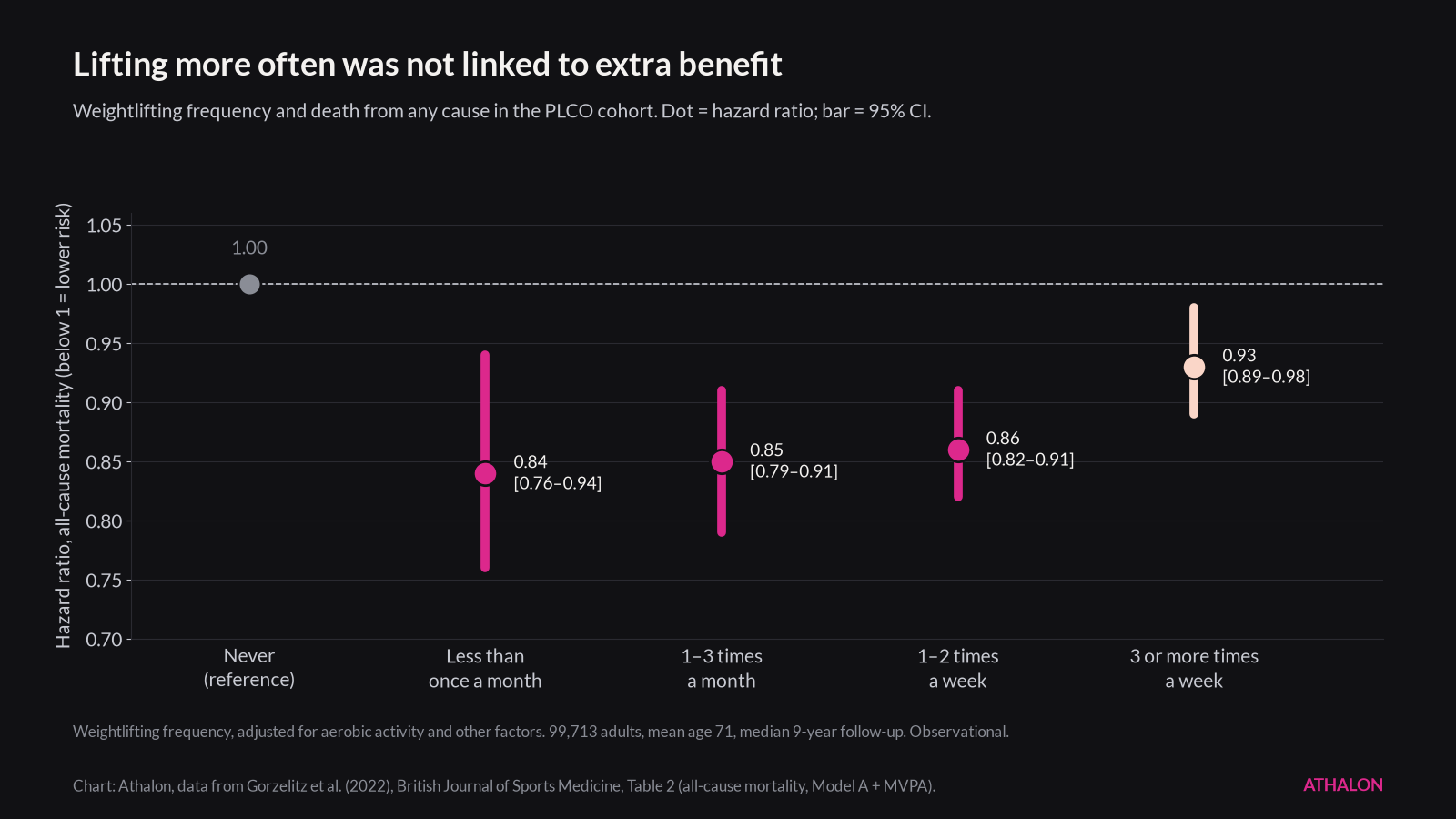
Chart: Athalon, data from Gorzelitz et al. (2022), British Journal of Sports Medicine, Table 2 (all-cause mortality, Model A + MVPA).
Why would more look worse? Nobody knows yet. The authors say the effect of higher volumes is "unclear" and that the dose analyses rest on few studies (Momma et al., 2022). These studies measured mortality, not performance, so they do not tell athletes to cap their training.
Photo: Senior Airman Haiden Morris, U.S. Air Force / Wikimedia Commons (from DVIDS), public domain (resized). Weights are added to a barbell during a gym powerlifting competition at Spangdahlem Air Base, Germany, September 2025. Use of U.S. military imagery does not imply DoD endorsement.
Lifting Plus Cardio: The Strongest Combination
The lowest risks showed up when people did both. Combined muscle-strengthening and aerobic activity was linked to a 40% lower risk of all-cause mortality compared with doing neither (Momma et al., 2022). In the older-adult cohort, people who met aerobic guidelines and lifted 1–2 times a week had a 41% lower risk than those who did neither (Gorzelitz et al., 2022).
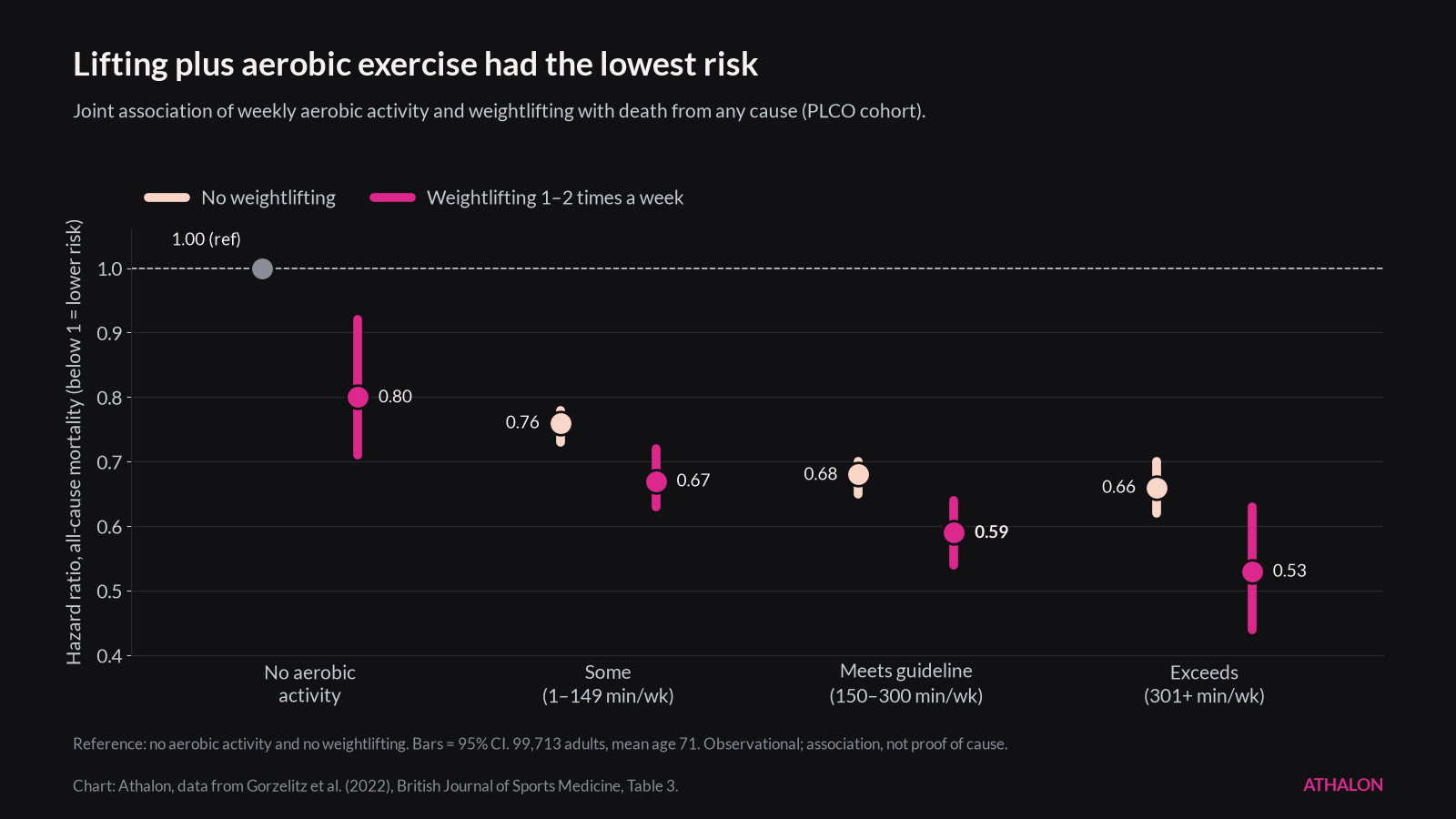
Chart: Athalon, data from Gorzelitz et al. (2022), British Journal of Sports Medicine, Table 3.
Lifting does not replace cardio. In a cohort of 216,339 older adults, weight training was not associated with mortality risk among people who did no aerobic exercise (Shailendra et al., 2024), although a different cohort did find an association in that group (Gorzelitz et al., 2022). For the aerobic side, see our VO₂ max post.
The same 2024 cohort found larger associations in women than in men: 12% vs 3% lower all-cause mortality with any weight training (Shailendra et al., 2024).
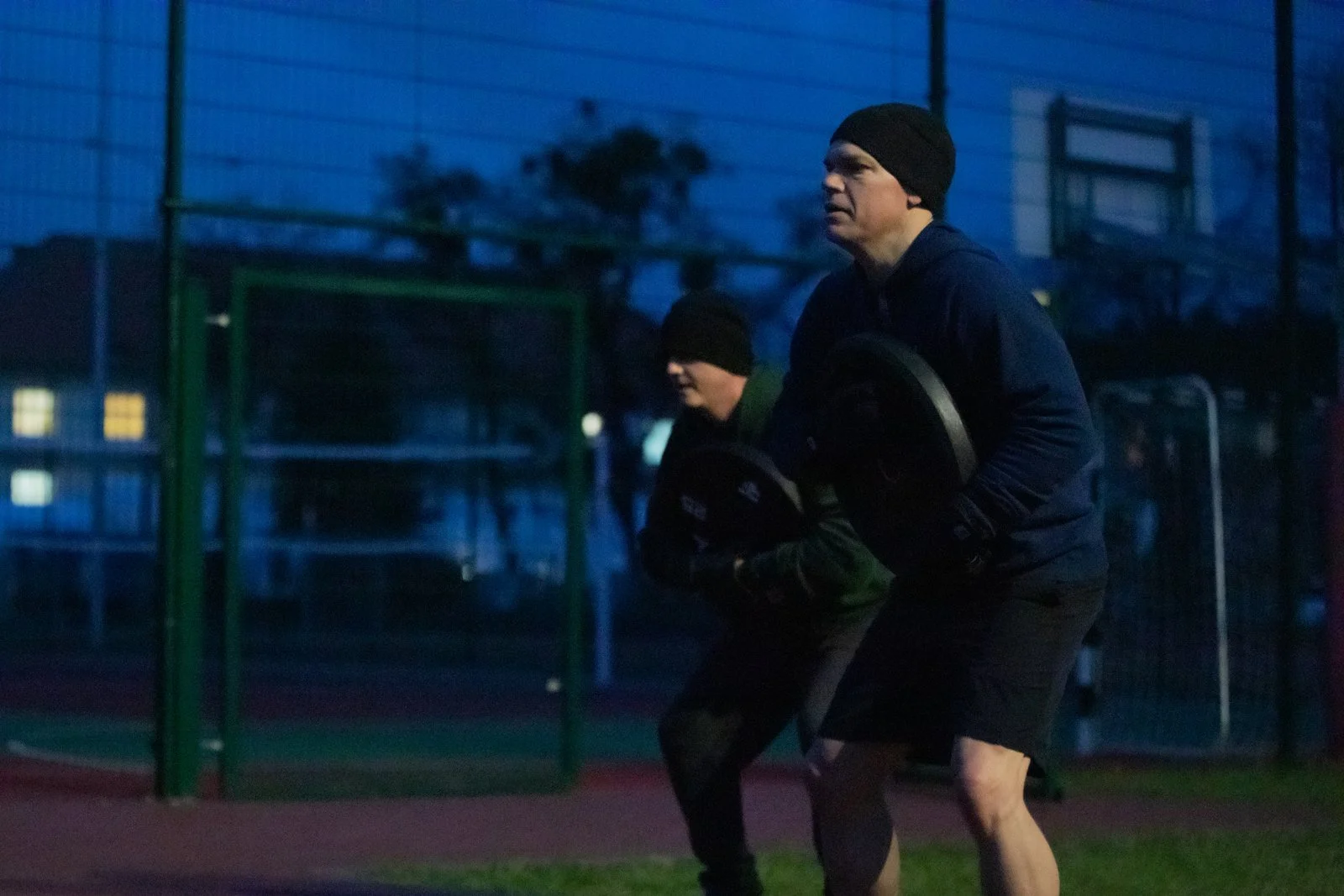
Photo: Sgt. Agustín Montañez, U.S. Army / Wikimedia Commons (from DVIDS), public domain (resized). U.S. Army Lt. Col. Daniel A. Hill squats while holding a 25-pound weight plate during a functional-fitness training event in Poznan, Poland, February 2022. Use of U.S. military imagery does not imply DoD endorsement.
Strength Training for Longevity: How to Apply the Evidence
Start with two sessions a week. Guidelines call for muscle-strengthening activities that work all major muscle groups on 2 or more days a week (guideline) (Bull et al., 2020). The mortality data suggest roughly 30–60 minutes a week captured the largest association (observational) (Momma et al., 2022).
Keep your cardio. The lowest risks were seen in people who did both (observational) (Gorzelitz et al., 2022).
Lift heavy enough to get stronger. Strength gains were enhanced by loads of at least 80% of one-repetition maximum, 2–3 sets, full range of motion and at least 2 sessions a week (overview of trials) (Currier et al., 2026).
You don't need to train to failure. Training to momentary muscle fatigue did not consistently improve outcomes; ACSM suggests stopping near failure, around 2–3 repetitions in reserve (overview of trials) (Currier et al., 2026).
Add some power work as you age. Power training enhanced physical function (overview of trials) (Currier et al., 2026). For older adults, WHO recommends varied activity that emphasizes functional balance and strength training on 3 or more days a week, to enhance functional capacity and prevent falls (guideline) (Bull et al., 2020).
If you love training more, that's fine. Whether high volumes carry any downside for longevity is untested; the J-shaped curves come from few studies (Momma et al., 2022).
Limitations
The mortality findings come from observational studies, which show associations rather than cause and effect. Muscle-strengthening was self-reported, the certainty of evidence was rated generally very low, and publication bias could not be tested (Momma et al., 2022). Participants in the 216,339-person cohort were mostly older, White adults with more education and better health than the general population (Shailendra et al., 2024). ACSM states that resistance training is safe for healthy adults of all ages; in an analysis of more than 38,000 participants, exercise did not increase the risk of serious adverse events (Currier et al., 2026). If you have a heart condition, joint problem or other medical concern, talk to a qualified clinician before starting.
Conclusion: A Little Lifting Goes a Long Way
The evidence favors consistency over volume. Some muscle-strengthening, roughly two sessions or 30–60 minutes a week, was linked to a meaningfully lower risk of early death, and the largest associations appeared when lifting was paired with aerobic exercise.
Train for strength, keep your cardio, and build a routine you can keep for decades. More lifting can still serve your performance goals; for longevity alone, the data suggest you don't need much to benefit.
Lift consistently, and track it. In the Athalon app you can log your lifts and runs, create competitions with friends and see where everyone stands on the leaderboard, which can make two sessions a week easier to keep. Download Athalon on the App Store.
Frequently Asked Questions
Q: How much strength training do you need to live longer?
A: The largest associations appeared at about 30–60 minutes of muscle-strengthening activity a week, in line with guidelines of 2 or more days a week (Momma et al., 2022; Bull et al., 2020).
Q: Is more strength training better for longevity?
A: Not clearly. A dose-response analysis of 4 studies found the largest risk reduction at around 60 minutes a week, with smaller reductions at higher volumes (Shailendra et al., 2022).
Q: Can lifting replace cardio?
A: The evidence says do both. Lifting plus aerobic activity was linked to a 40% lower risk of death from any cause (Momma et al., 2022).
Q: Is it too late to start strength training in older age?
A: The research suggests not. In a cohort with an average age near 70, any weight training was linked to lower mortality (Shailendra et al., 2024), and the NSCA recommends resistance training for older adults (Fragala et al., 2019).
References
American College of Sports Medicine. (2026, October 20). Wearables hold top spot in ACSM's 2027 fitness trends [Press release]. https://acsm.org/2027-fitness-trends/
Bull, F. C., Al-Ansari, S. S., Biddle, S., Borodulin, K., Buman, M. P., Cardon, G., Carty, C., Chaput, J.-P., Chastin, S., Chou, R., Dempsey, P. C., DiPietro, L., Ekelund, U., Firth, J., Friedenreich, C. M., Garcia, L., Gichu, M., Jago, R., Katzmarzyk, P. T., … Willumsen, J. F. (2020). World Health Organization 2020 guidelines on physical activity and sedentary behaviour. British Journal of Sports Medicine, 54(24), 1451–1462. https://doi.org/10.1136/bjsports-2020-102955
Coleman, C. J., McDonough, D. J., Pope, Z. C., & Pope, C. A. (2022). Dose–response association of aerobic and muscle-strengthening physical activity with mortality: A national cohort study of 416 420 US adults. British Journal of Sports Medicine, 56(21), 1218–1223. https://doi.org/10.1136/bjsports-2022-105519
Currier, B. S., D'Souza, A. C., Singh, M. A. F., Lowisz, C. V., Rawson, E. S., Schoenfeld, B. J., Smith-Ryan, A. E., Steen, J. P., Thomas, G. A., Triplett, N. T., Washington, T. A., Werner, T. J., & Phillips, S. M. (2026). American College of Sports Medicine position stand: Resistance training prescription for muscle function, hypertrophy, and physical performance in healthy adults: An overview of reviews. Medicine & Science in Sports & Exercise, 58(4), 851–872. https://doi.org/10.1249/MSS.0000000000003897
Fragala, M. S., Cadore, E. L., Dorgo, S., Izquierdo, M., Kraemer, W. J., Peterson, M. D., & Ryan, E. D. (2019). Resistance training for older adults: Position statement from the National Strength and Conditioning Association. Journal of Strength and Conditioning Research, 33(8), 2019–2052. https://doi.org/10.1519/JSC.0000000000003230
Gorzelitz, J., Trabert, B., Katki, H. A., Moore, S. C., Watts, E. L., & Matthews, C. E. (2022). Independent and joint associations of weightlifting and aerobic activity with all-cause, cardiovascular disease and cancer mortality in the Prostate, Lung, Colorectal and Ovarian Cancer Screening Trial. British Journal of Sports Medicine, 56(22), 1277–1283. https://doi.org/10.1136/bjsports-2021-105315
Momma, H., Kawakami, R., Honda, T., & Sawada, S. S. (2022). Muscle-strengthening activities are associated with lower risk and mortality in major non-communicable diseases: A systematic review and meta-analysis of cohort studies. British Journal of Sports Medicine, 56(13), 755–763. https://doi.org/10.1136/bjsports-2021-105061
Saeidifard, F., Medina-Inojosa, J. R., West, C. P., Olson, T. P., Somers, V. K., Bonikowske, A. R., Prokop, L. J., Vinciguerra, M., & Lopez-Jimenez, F. (2019). The association of resistance training with mortality: A systematic review and meta-analysis. European Journal of Preventive Cardiology, 26(15), 1647–1665. https://doi.org/10.1177/2047487319850718
Shailendra, P., Baldock, K. L., Li, L. S. K., Bennie, J. A., & Boyle, T. (2022). Resistance training and mortality risk: A systematic review and meta-analysis. American Journal of Preventive Medicine, 63(2), 277–285. https://doi.org/10.1016/j.amepre.2022.03.020
Shailendra, P., Baldock, K. L., Li, L. S. K., Gorzelitz, J., Matthews, C. E., Trabert, B., Bennie, J. A., & Boyle, T. (2024). Weight training and risk of all-cause, cardiovascular disease and cancer mortality among older adults. International Journal of Epidemiology, 53(3), dyae074. https://doi.org/10.1093/ije/dyae074
